
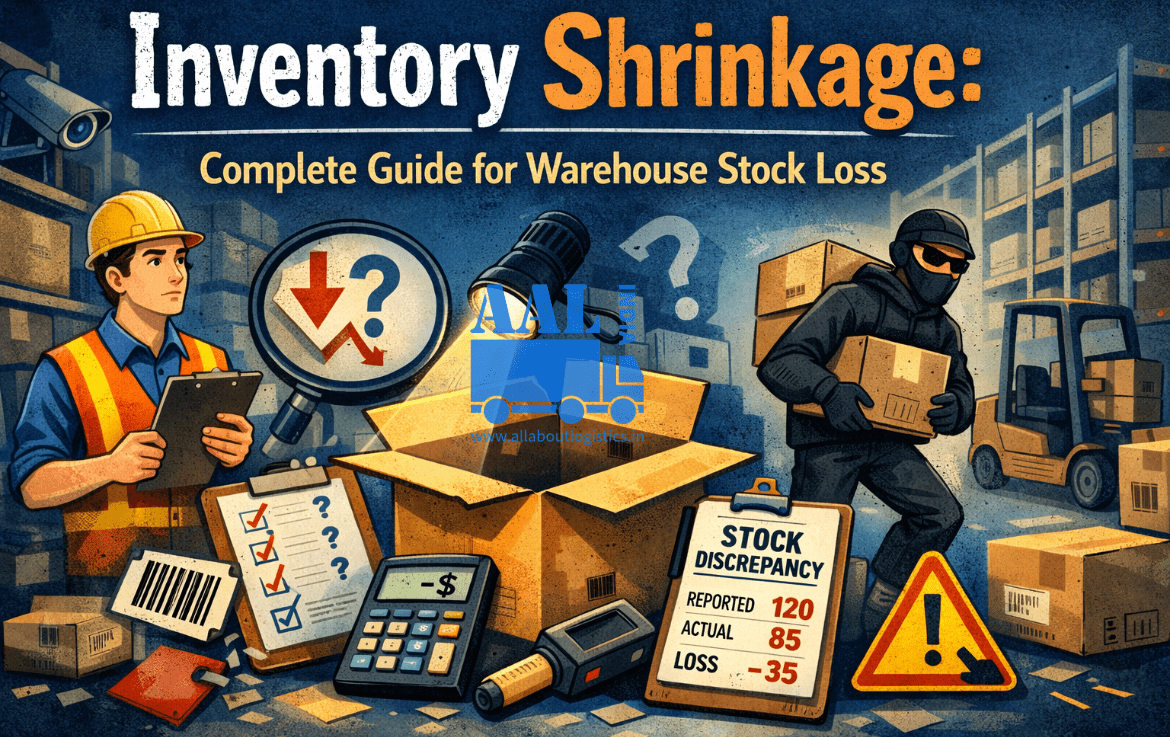
Inventory shrinkage happens when the stock recorded in the system is higher than the stock physically available in the warehouse.
Even a small shrinkage percentage can lead to significant financial losses for businesses managing large inventories. This usually means that some products are missing, damaged, misplaced, or entered incorrectly in the system.
इसका मतलब यह होता है कि कुछ सामान गायब हो गया है, खराब हो गया है, गलत जगह रखा गया है या सिस्टम में एंट्री गलत हुई है।
What is Inventory Shrinkage?
Inventory shrinkage is the difference between the stock recorded in the warehouse management system and the actual stock counted on the warehouse floor.
Basic Formula
Shrinkage Amount = System Stock − Physical Stock
Shrinkage Rate (%) = (Shrinkage Amount ÷ System Stock) × 100
Example
A warehouse system shows 1,000 cartons of packaged juice. During physical counting, only 960 cartons are found.
Shrinkage Amount = 40 cartons.
Shrinkage Rate = 4%.
Example 2
Suppose a warehouse system shows 1,000 cartons of packaged juice.
During a physical count, only 960 cartons are found.
Shrinkage Amount = 40 cartons
Shrinkage Rate = 4%
Example 3 (Inventory Shrinkage in ColdStore )
In a cold storage warehouse, the system records 10,000 kg of potatoes.
During physical verification only 9,500 kg are found.
The missing 500 kg could be due to spoilage, misplacement, theft, or incorrect data entry.
Main Causes of Inventory Shrinkage
- Theft: Inventory stolen by employees or outsiders.
- Damage: Products break or spoil during storage.
- Misplacement: Items stored in the wrong bin or location.
- Data Entry Errors: Mistakes during GRN, dispatch, or transfer entries.
- Supplier Shortage: Vendor sends fewer items than invoiced.
- Poor Warehouse Processes: Picking or scanning mistakes.
- Environmental Factors: Heat, humidity, or pests damaging goods.
- Administrative Errors: Missing adjustments in the system.
How to Measure Inventory Shrinkage
Warehouse managers measure shrinkage through regular inventory counting and reconciliation.
- ABC analysis to prioritize high-value items.
- Blind counting without checking system stock.
- Reconciliation between physical and system stock.
- Root cause analysis using methods like 5-Why.
| Metric | Formula | Target |
|---|---|---|
| Shrinkage Rate | (System − Physical) ÷ System × 100 | Below 1% |
| Annual Loss | Shrinkage Rate × Inventory Value | Minimize |
Business Impact of Inventory Shrinkage
- Direct financial loss.
- Stockouts and delayed customer orders.
- Operational inefficiencies.
- Reduced customer satisfaction.
12 Ways to Prevent Inventory Shrinkage
- Install CCTV and control warehouse access.
- Train staff regularly.
- Double-check quantities during goods receipt.
- Follow FIFO or FEFO inventory rotation.
- Conduct regular cycle counts.
- Use barcode scanning or RFID tracking.
- Monitor vendor performance.
- Use inventory management software.
- Maintain pest control.
- Track returns and damaged items properly.
- Generate daily stock reports.
- Promote accountability and audits.
Indian Case Studies
- E-commerce warehouses reduced shrinkage using RFID tracking.
- Cold chain warehouses reduced spoilage with better monitoring.
- Textile warehouses improved inventory accuracy through regular cycle counting.
FAQs
What is a normal shrinkage rate?
Most warehouses aim to keep shrinkage below 1–2%.
How can shrinkage be reduced?
By improving warehouse processes, conducting regular cycle counts, and using accurate inventory tracking systems.
Conclusion
Inventory shrinkage cannot be fully eliminated, but it can be controlled with better warehouse management practices.
Regular stock counting, good processes, and accurate system tracking help warehouses maintain inventory accuracy and reduce losses.
2 thoughts on “<title>Inventory Shrinkage: Simple Guide for Warehouse Stock Loss</title>”