
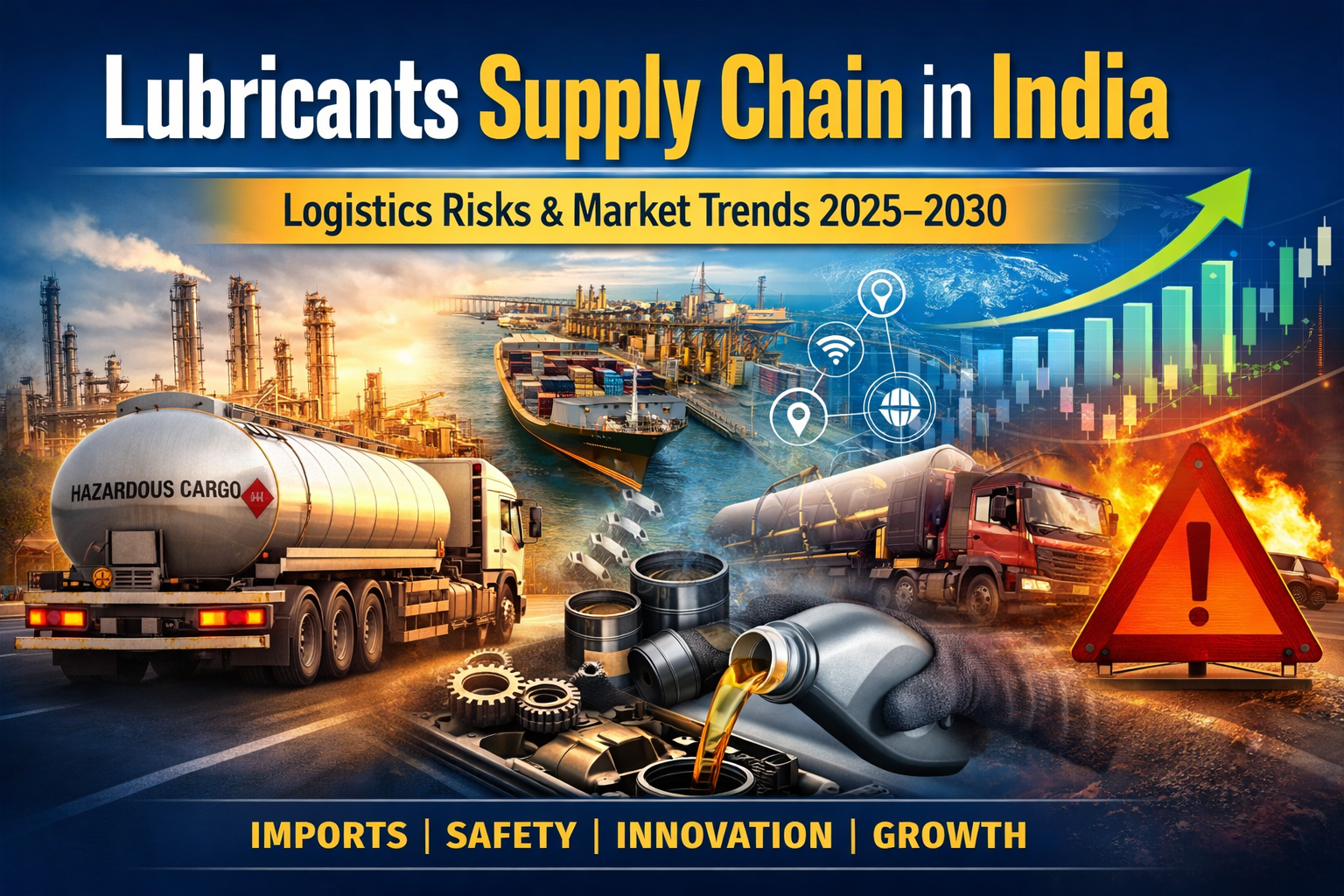
The lubricants supply chain in India underpins an industry exceeding 5.60 billion liters in 2025 and is expected to expand consistently until 2030. This critical ecosystem enables smooth operations across automotive, industrial, and manufacturing sectors by delivering reliable lubrication solutions from refineries to final users. With increasing vehicle output and the growing influence of electric mobility, the supply chain is under pressure from import dependence, logistical constraints, and transportation-related safety hazards.
Operational effectiveness within this supply chain has a direct bearing on cost efficiency, engine durability, and environmental protection. Rising fuel expenses and tighter emission regulations are forcing organizations to reassess each link—from sourcing raw materials to last-mile distribution. This guide explains the complete framework, examines major operational risks including accidents, and outlines practical improvement strategies.
What is the Lubricants Supply Chain?
The lubricants supply chain represents an interconnected system involving base oil refiners, blending units, distributors, and end consumers. The process starts with refining crude oil into base stocks, which are then combined with additives to produce application-specific lubricants such as engine oils and hydraulic fluids. In India, this system caters to a wide spectrum—from two-wheelers to heavy-duty industrial equipment—serving a market supported by nearly 25 million vehicle sales annually.
Large players control the market through extensive depot and retail networks. Public sector enterprises benefit from vertically integrated operations, while global brands contribute advanced synthetic products. The resilience of this chain lies in maintaining consistent quality across vast distances and climatic variations. Any disruption quickly impacts nationwide pricing and supply availability.
International linkages play a vital role, as a significant portion of base oils is imported. Ports such as JNPT and Chennai act as primary entry points, supplying inland blending facilities. The customer base spans OEMs like Tata and Mahindra, service workshops, and industrial users, resulting in varied demand dynamics.
Stages of the Lubricants Supply Chain
Raw Material Sourcing
The supply chain begins with crude oil processing, where base oils are produced through refining, cracking, and purification techniques. Approximately 60–70% of India’s base oil requirement is met through imports from the Middle East and Southeast Asia, as domestic refineries focus mainly on fuel production. Additives, accounting for 10–30% of formulations, include detergents, anti-wear chemicals, and viscosity enhancers sourced from specialized chemical manufacturers.
Accurate sourcing is essential to meet quality classifications such as Group II and Group III, particularly for synthetic lubricants. Fluctuations in crude prices directly influence production costs, leading blenders to rely on hedging and buffer inventories. Rigorous quality checks at this stage help avoid performance failures later.
Manufacturing and Blending
Blending facilities combine base oils and additives in precise proportions to produce lubricants for engines, gear systems, and industrial machinery. Plants located in northern and western India manage high-volume output while complying with international standards like API SN and CK-4. Advanced automation ensures uniformity through controlled temperature and mixing processes.
After blending, products undergo filtration and performance testing. With BS-VI norms driving demand for superior heat resistance, manufacturers are expanding synthetic lubricant capacity. This stage is crucial for ensuring dependable performance under demanding operating conditions.
Packaging and Warehousing
Final products are packed into bottles, drums, IBCs, or bulk containers. High-speed packaging lines handle filling, sealing, and labeling, often in controlled environments to prevent contamination. Warehousing facilities incorporate temperature management systems to maintain lubricant stability, especially for premium synthetic grades.
Inventory is managed using FIFO principles and batch-level traceability enabled by barcodes or RFID. Warehouses positioned near major transport corridors reduce lead times, while fire safety systems mitigate storage-related hazards.
Distribution and Logistics
Bulk lubricants are transported using certified tankers equipped with heating mechanisms and hazardous material approvals. While road transport remains dominant, railways and pipelines are increasingly used for long-distance efficiency. Logistics partners employ GPS-based routing to reduce delays and fuel consumption.
Imported volumes move through ports and are transported inland via multi-axle trucks. Last-mile distribution serves OEMs and retail outlets, often supported by value-added service programs. Live tracking systems help prevent pilferage and product degradation.
End-User Delivery and Consumption
Lubricants reach service centers, manufacturing plants, and fleet operators. Automotive lubricants experience frequent turnover due to regular oil changes, whereas industrial lubricants operate on extended life cycles. Used oil collection and recycling initiatives support sustainability objectives.
Customer feedback influences product innovation, including fluids designed for electric vehicles. Strong dealer networks enhance market penetration and customer retention.
India Lubricants Market Insights
India is one of the world’s largest lubricant consumers, supported by expanding automotive production and industrial growth. Engine oils dominate consumption, followed by hydraulic and gear oils. Synthetic lubricants represent the fastest-growing segment, driven by premium vehicles and longer service intervals.
Metropolitan regions such as Delhi-NCR, Mumbai, Chennai, and Pune generate significant demand due to dense industrial activity. Southern automotive clusters and northern agricultural equipment markets form additional demand centers.
Logistics Challenges in India
Infrastructure constraints, weather disruptions, and regulatory complexities challenge daily operations. Monsoon conditions alone delay nearly one-fifth of shipments. Import duties, GST compliance, and volatile base oil prices further pressure margins.
Driver fatigue and skill gaps exacerbate risks, while inadequate rural infrastructure increases transit distances. Global geopolitical factors also contribute to fluctuating freight costs.
Major Accidents and Risks
Lubricants fall under Class 3 flammable liquids, making transportation accidents particularly dangerous. Spills, fires, and explosions can result from collisions or leaks, often intensified by poor road conditions.
Key Statistics
Between 2014 and 2019, public sector oil companies recorded more than 200 significant accidents during fuel and lubricant transportation. Overspeeding accounted for roughly 40%, driver fatigue 20%, and mechanical issues 15%. Such incidents cause fatalities and financial losses worth crores annually.
Notable Cases
- Jaipur tanker incident (2025): A bulk tanker overturned during a U-turn, triggering a large fire due to infrastructure and equipment shortcomings, leading to casualties and evacuations.
- IOCL transport accidents: Speed violations resulted in severe collisions, with unauthorized access causing depot fires.
- Bahadurgarh loading mishap: Failure of insulation during petrol loading led to explosions and operational shutdowns.
International disasters such as the Atlantic Empress collision demonstrate the scale of potential damage, including environmental harm, supply disruption, and rising insurance costs.
Root Causes
- Inadequate driver training and nighttime driving hazards
- Old tanker designs without modern safety baffles
- Overloading on undivided and congested highways
These incidents highlight the urgent need for strict safety compliance.
Technology Solutions for Efficiency and Safety
IoT-enabled sensors monitor tanker temperature and movement, issuing alerts for abnormalities. AI-driven transport management systems forecast delays and optimize routing, reducing fuel usage by up to 15%.
Blockchain technology ensures product traceability and combats counterfeit lubricants. Drones assist in inspecting remote facilities, while predictive analytics supports proactive maintenance. ERP integration enables vendor-managed inventory models.
Digital twin technology improves blending efficiency, while telematics-based speed governance has reduced accident rates by nearly 25%.
Best Practices for Optimization
- Use of dedicated tanker fleets to avoid contamination
- Vendor-managed inventory achieving near-perfect fill rates
- OISD-compliant driver training programs
- Greater reliance on rail transport for bulk movement
- Adoption of bio-based lubricants for ESG compliance
- Centralized dashboards for real-time supply chain visibility
Future Trends 2026–2030
The expansion of electric vehicles will shift lubricant demand toward specialized gear oils and coolants, with synthetics approaching a 40% market share. Domestic base oil production is expected to rise to 20%, reducing import reliance.
Re-refining of used oil will support circular economy goals, while hydrogen mobility will drive new lubricant formulations. Automation, AI, and drone-based deliveries will increasingly define logistics operations.
Government incentives under Make in India will strengthen refining capacity, and environmental certifications such as ISO 14001 will become standard requirements.
Case Study: National Hub Optimization
A major lubricant manufacturer optimized its central distribution hub using GPS-enabled routing and multimodal transport, reducing delivery delays by 30%. Similar measures in lubricant logistics improved driver safety, lowered accident rates, and reduced costs through load consolidation.
Career Tips for Logistics Professionals
Professionals should prioritize hazardous material certifications and ERP expertise, particularly for PSU roles. Lean Six Sigma skills support continuous improvement initiatives, while industry networking opens opportunities with leading 3PL providers.