
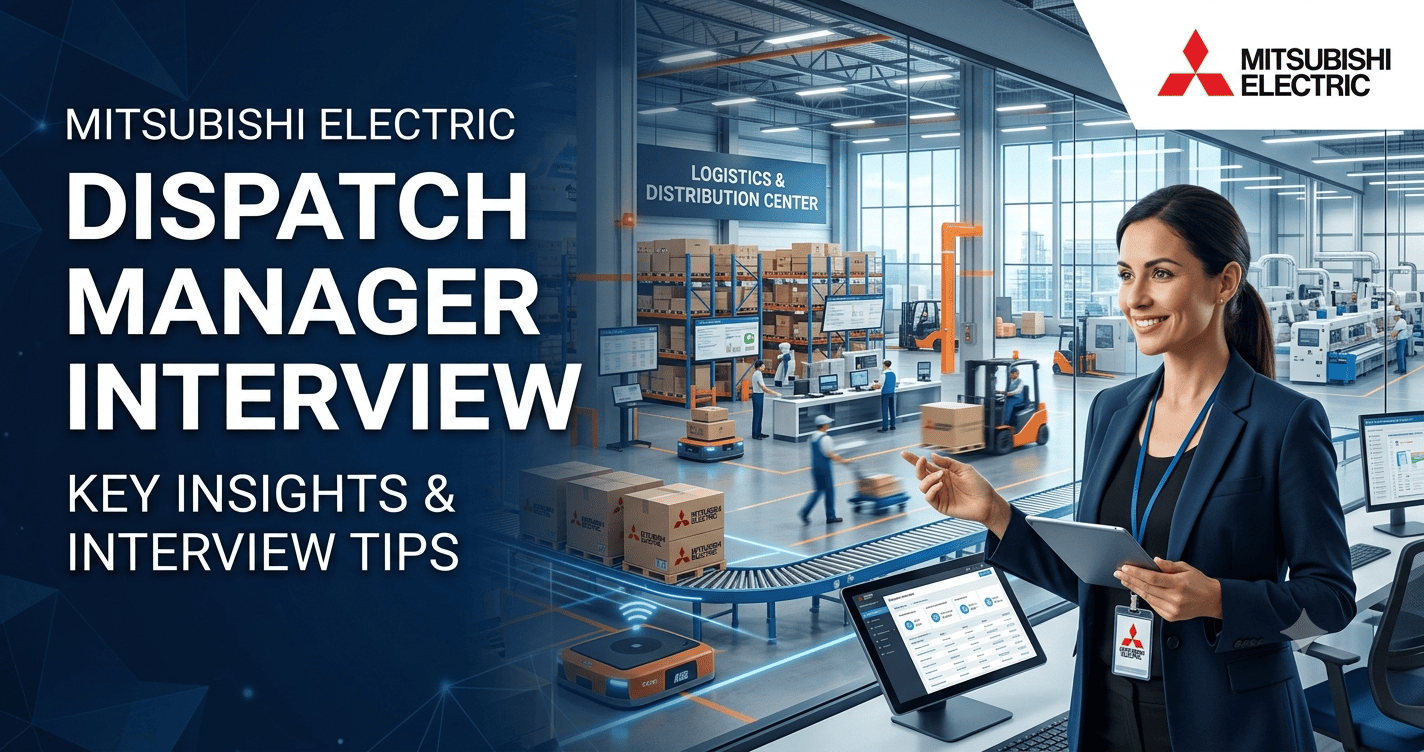
How to Prepare for a Dispatch Assistant Manager Interview in Mitsubishi Electric
A Dispatch Assistant Manager role is not only about sending goods from one place to another. It is about managing dispatch operations, customer coordination, delivery performance, documentation, reporting, and quality compliance in a structured manufacturing environment. In a company like Mitsubishi Electric, the role becomes even more important because dispatch connects production, logistics, quality, and customer service.
If you are preparing for this interview, you must understand what the job really means, what each responsibility involves, how to answer interview questions, and what salary you can expect in India.
What This Role Means
A Dispatch Assistant Manager is responsible for ensuring that finished goods, spare parts, and customer orders are shipped correctly, on time, and with proper documents. The work includes daily coordination with production, planning, warehouse, transport vendors, customer teams, and internal line or supply chain members. In this role, you are expected to maintain delivery commitments and keep operations smooth.
For Mitsubishi Electric-type operations, the company usually expects process discipline, accuracy, and strong coordination. That means the interviewer will not only ask whether you can dispatch materials, but also whether you can handle delays, manage changes, and maintain complete records.
Main Responsibilities
1. OEM (Original Equipment Manufacturer) and Tier 2 (Second-Level Supplier) Dispatch Handling
This means dispatching goods to original equipment manufacturers and their supply chain partners. These customers are strict about timing, packaging, documentation, and quantity accuracy. You should show that you understand how important it is to follow customer schedules and avoid supply interruptions.
2. Maintaining 100% Delivery Performance
100% delivery means shipments should reach the customer as per requirement, without missing quantity, timing, or documentation. In the interview, explain how you monitor pending orders, coordinate with transport, follow up with internal teams, and handle urgent changes to protect delivery performance.
3. Coordination with MSIL (Maruti Suzuki India Limited) Line and SC (Supply Chain) Members
This refers to regular communication with line and supply chain members to track schedule changes and production requirements. The interviewer may want to know how you manage daily updates, schedule revisions, and last-minute changes without affecting customer supply.
4. SICV (Company-Specific Dispatch Confirmation Record)
SICV is usually a company-specific dispatch or supply confirmation process. Since terminology may vary, you should learn how the company defines it. In the interview, explain that you ensure all supply records are updated accurately and on time so that dispatches remain traceable and approved.
5. Dispatch Operations and Excel Work
This includes creating dispatch reports, updating pending lists, checking shortages, tracking dispatch movement, and handling daily documentation. If the company uses Excel heavily, you should be prepared to discuss formulas, lookups, reporting sheets, and data accuracy.
6. Spares Supply Dispatch
Spares dispatch is often urgent because customer equipment downtime can depend on it. In the interview, explain how you prioritize critical spares, coordinate with transport, and ensure faster delivery where needed.
7. IATF (International Automotive Task Force) and ISO (International Organization for Standardization) Documentation
This is a strong quality-management responsibility. Dispatch is not just a logistics activity; it is also part of quality control and traceability. The role may involve supporting audit records, maintaining dispatch documents, and following procedures for handling, storage, packaging, preservation, and delivery.
8. Invoice and Report Support
The role also includes supporting billing and report preparation. That may mean verifying dispatch details before invoicing, preparing supplementary documents if required, and maintaining records for management or audit review. Accuracy matters because mistakes can affect finance, customers, and compliance.
How to Prepare for the Interview
Your preparation should focus on company understanding, role knowledge, technical skills, and communication. Learn about Mitsubishi Electric’s business style, its structured work environment, and the importance of delivery accuracy in manufacturing operations. That will help you answer questions in a practical way.
You should also study the complete dispatch cycle: order receipt, planning, material readiness, packing, loading, transport movement, delivery confirmation, and report closure. If you can explain this flow clearly, the interview panel will see that you understand real operational work.
Technical Areas to Revise
- Dispatch planning and execution.
- Customer and transporter coordination.
- Inventory and shortage tracking.
- Invoice checking and supplementary document support.
- Excel-based reporting.
- ERP (Enterprise Resource Planning) or SAP (Systems, Applications, and Products in Data Processing) basics, if applicable.
- IATF (International Automotive Task Force) and ISO (International Organization for Standardization) documentation awareness.
Common Interview Questions
You should prepare for questions about your experience, documentation, problem-solving, and teamwork. Typical questions include how you ensure 100% delivery, how you handle urgent customer changes, how you manage dispatch pressure, and how you coordinate with production and supply chain teams.
The interviewer may also ask about documents required before dispatch, how you handle invoice mismatches, what you do if a vehicle is delayed, and how you support IATF and ISO records. Your answers should focus on process, ownership, and accuracy.
How to Answer Effectively
A strong interview answer should have four parts: situation, action, result, and learning. For example, if asked how you ensure 100% delivery, explain that you review pending orders daily, coordinate with planning and transport teams, track vehicle movement, and follow up until delivery is confirmed.
This type of answer sounds professional because it shows process control, not just task handling. The panel wants a candidate who can manage deadlines, communicate clearly, and solve operational issues quickly.
Skills to Highlight
- Dispatch planning.
- Customer coordination.
- Time management.
- Problem solving.
- Reporting accuracy.
- Documentation control.
- Quality system awareness.
- Excel and data management.
- Urgency in spares supply.
Salary Expectation in India
Another source shows a wider band of approximately ₹12.04 lakh per year for a Dispatch Manager profile, depending on experience and role scope. A separate salary profile reports an average around ₹15.5 lakh per year for a limited set of profiles, which suggests that seniority and company type can significantly affect pay.
Practical Salary View
- Entry or junior dispatch roles usually pay less.
- Mid-level dispatch roles with OEM (Original Equipment Manufacturer) or Tier 2 (Second-Level Supplier) exposure pay more.
- Roles with IATF (International Automotive Task Force), ISO (International Organization for Standardization), ERP (Enterprise Resource Planning), and reporting responsibility usually command better pay.
- Large manufacturing companies may offer higher compensation based on skills and location.
How to Present Yourself
You should present yourself as someone who can manage both operations and control. The role is not only about loading trucks and sending goods. It is about ensuring delivery commitment, tracking changes, supporting quality compliance, and keeping customers satisfied.
A strong self-introduction could be: “I have experience in dispatch handling, OEM (Original Equipment Manufacturer) and Tier 2 (Second-Level Supplier) customer coordination, delivery monitoring, spares dispatch, documentation support, and reporting. I am familiar with IATF (International Automotive Task Force) and ISO (International Organization for Standardization) based working systems and can manage dispatch operations with accuracy and ownership.”
Final Preparation Tips
Before the interview, prepare examples from your own work where you handled delivery pressure, solved dispatch issues, supported documentation, or coordinated with internal teams. Use real process details instead of only general statements.
If you can explain the dispatch cycle, quality documentation, report handling, and customer coordination in simple and confident language, you will already be ahead of many candidates.