FMCG CFA Operations Explained: Complete Guide with Indian Examples
FMCG CFA operations are an important part of the supply chain of FMCG companies. CFA stands for Carrying and Forwarding Agent.
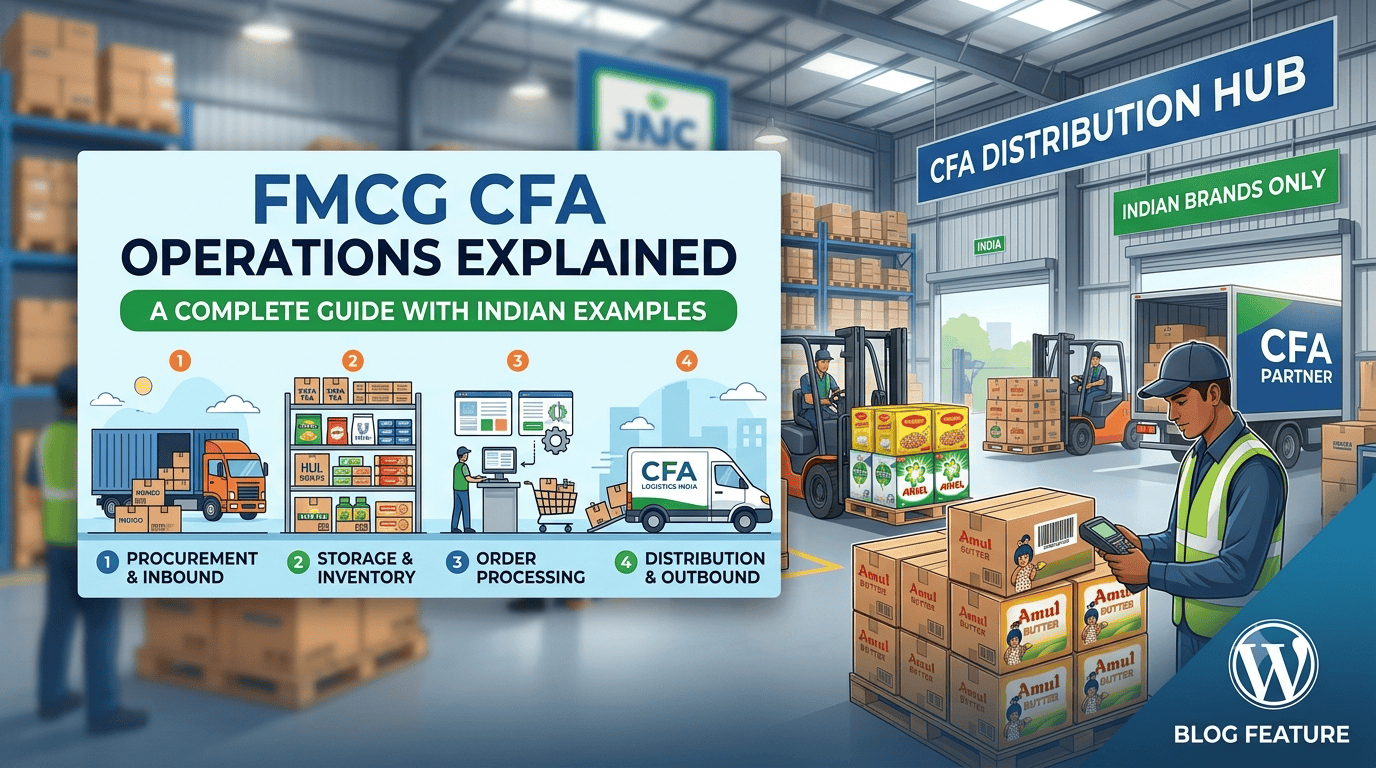
In simple words, a CFA works as a regional warehouse and distribution point for an FMCG company. The company sends products in bulk to the CFA. The CFA stores the products and then sends them to distributors according to their orders.
This system helps FMCG companies distribute their products across different states and regions without having to operate their own warehouses everywhere.
India has a very large geographical area and a complex distribution network. Because of this, CFAs play an important role in helping brands move products from factories to distributors and finally to retail stores.
Simple example:
What is a CFA in FMCG?
A Carrying and Forwarding Agent (CFA) is a logistics and warehousing partner appointed by an FMCG company to manage stock at a state or regional level.
The CFA generally does not purchase the company’s stock. The ownership of the inventory remains with the FMCG company. The CFA provides services such as warehousing, handling, order processing, dispatch and documentation and receives a service fee for these activities.
Typical FMCG Distribution Chain in India
For example, a company may manufacture products in one state and send bulk stock to a CFA located closer to its distributors. The CFA then supplies the required quantity to distributors across different cities.
This model helps companies manage their distribution network efficiently, especially when they have a large number of products, distributors and retail outlets.
Why Do FMCG Companies Use CFAs?
FMCG companies deal with thousands or even millions of products moving through their supply chains every day.
Instead of sending small shipments directly from factories to every distributor, companies can keep stock at regional CFA warehouses.
This helps in:
- Reducing transportation distance
- Improving product availability
- Reducing pressure on manufacturing locations
- Serving distributors faster
- Managing regional inventory
- Improving control over the distribution network
Core Functions of CFA Operations
1. Goods Receipt and Storage
The first major responsibility of a CFA is receiving products from the manufacturing plant or another company warehouse.
- Receive full truckloads from manufacturing plants or central warehouses
- Check the quantity received
- Check products for damage
- Verify batch numbers
- Check manufacturing and expiry dates
- Store products in the correct warehouse location
- Maintain separate areas for ambient, chilled or temperature-controlled products when required
Proper receiving is important because any mistake at this stage can create inventory problems later.
2. Inventory Management
Inventory management is one of the most important parts of CFA operations.
The CFA needs to know how much stock is available, which products are moving quickly and which products are moving slowly.
- Monitor stock levels regularly
- Use WMS or other systems to track inventory
- Maintain batch-wise stock records
- Follow FIFO or FEFO wherever required
- Conduct regular stock audits
- Identify slow-moving and ageing inventory
- Inform the company when replenishment is required
Good inventory control helps reduce both stockouts and excess inventory.
3. Order Processing and Dispatch
Once a distributor places an order, the CFA warehouse team receives the order through the company’s ERP, DMS or other order management system.
The warehouse team then processes the order and prepares it for dispatch.
- Receive distributor orders
- Generate pick lists
- Pick the required products
- Check quantity and batch details
- Pack and label the order
- Prepare dispatch documents
- Load the vehicle
- Dispatch the order to the distributor
Warehouse teams normally try to arrange picking in a way that reduces unnecessary movement inside the warehouse and improves productivity.
4. Documentation and Compliance
CFA operations also involve a large amount of documentation.
Depending on the business and operating model, the CFA may handle or support activities such as:
- GST-related documentation
- E-way bills
- Invoices
- Delivery documents
- Stock statements
- Damage and shortage reports
- Records required for audits
Accurate documentation is important because FMCG companies handle large volumes of stock and transactions every day.
5. Transportation Coordination
After an order is picked and packed, it needs to reach the distributor.
The CFA may coordinate with transport vendors for this activity.
- Plan vehicles according to dispatch requirements
- Coordinate with transport vendors
- Plan local and outstation deliveries
- Track vehicles through GPS or TMS
- Monitor delivery timelines
- Follow up on delayed shipments
Local distributor deliveries may be completed within a day, while deliveries to distant locations may require more time depending on distance and transport arrangements.
6. Reporting and Analytics
The CFA also provides regular operational information to the FMCG company.
Typical reports may include:
- Daily stock report
- Inbound report
- Dispatch report
- Damage report
- Shortage report
- Ageing stock report
- Slow-moving stock report
- Order fulfilment report
These reports help the company understand what is happening at the warehouse and identify operational problems quickly.
Example: Parle Agro CFA Operations
Parle Agro is one of India’s well-known FMCG companies, with brands such as Frooti, Appy Fizz, Bailley and Smoodh.
A company operating at such a large scale needs a strong distribution and logistics network to move products from manufacturing locations to distributors and retailers across India.
How a CFA Model Can Work for an FMCG Brand
- Regional Coverage: CFAs can act as regional or state-level distribution hubs close to the company’s distributor network.
- Inventory Management: CFA warehouses maintain the required stock of fast-moving and regular SKUs and ensure that distributors receive stock on time.
- Distributor Servicing: Distributors can place orders and collect or receive products from the CFA warehouse according to the company’s distribution process.
- Technology: ERP, WMS, TMS and sales automation systems can provide visibility of inventory, orders, dispatches and deliveries.
- Operations Management: Logistics and warehouse managers are responsible for warehouse productivity, inventory accuracy, manpower, transport coordination, vendor management and compliance.
Real-World Benefits of Using CFAs
- Serve distributors faster
- Keep products available closer to the market
- Reduce unnecessary transportation from factories
- Improve inventory control
- Manage batch and expiry-sensitive products
- Support the launch of new products across multiple markets
Example: Hindustan Unilever (HUL)
Hindustan Unilever (HUL) operates a large FMCG distribution network covering a wide range of products and markets.
For a company with products moving across thousands of locations, regional warehousing and distribution points can help maintain product availability closer to distributors and markets.
In a CFA-type operation, the key activities would include:
- Receiving products from manufacturing locations
- Maintaining inventory at regional locations
- Processing distributor orders
- Picking and dispatching products
- Managing batch and inventory accuracy
- Coordinating transportation
- Sharing operational reports with the company
Example: ITC FMCG Business
ITC has a large FMCG portfolio that includes brands such as Aashirvaad, Sunfeast and Bingo!.
Products such as packaged food and personal care products require an efficient distribution network because they need to reach distributors and retailers across urban as well as rural markets.
A regional warehouse or CFA operation can support this network by:
- Holding regional inventory
- Processing distributor orders
- Managing stock rotation
- Coordinating dispatches
- Supporting faster market replenishment
- Providing inventory and dispatch visibility
Examples of CFA-Type Operations in Other Industries
1. Pharmaceutical Industry
The pharmaceutical industry also needs strong regional warehousing because medicines have batch numbers, expiry dates and specific storage requirements.
A regional warehouse may receive medicines from the manufacturer, store them according to required conditions and dispatch them to distributors or stockists.
Here, batch tracking, FEFO, expiry management and temperature control can be especially important.
2. Automobile Spare Parts Industry
Automobile companies and spare-parts manufacturers also use regional distribution centres to keep frequently required parts closer to dealers and service centres.
A regional warehouse can receive parts from a central manufacturing facility and supply them to dealers across several cities.
The focus is usually on part availability, inventory accuracy, order fulfilment and quick transportation.
3. Consumer Electronics Industry
Consumer electronics companies also need regional distribution networks for products such as televisions, appliances, mobile accessories and other electronic products.
A regional warehouse can store products and dispatch them to distributors, dealers or large retail chains according to demand.
This helps companies position inventory closer to major markets and reduce delivery time.
CFA vs Super Stockist: What’s the Difference?
| Feature | CFA | Super Stockist |
|---|---|---|
| Stock Ownership | Stock generally remains owned by the brand | Super stockist purchases and owns the inventory |
| Revenue Model | Service fee or handling charges | Margin earned on resale |
| Main Role | Warehousing, handling and forwarding | Stock ownership and distribution |
| Coverage | Usually state or regional level | Usually smaller territories or markets |
| Infrastructure | Warehouse, manpower and handling infrastructure | Warehouse and distribution infrastructure |
| Best Suited For | Centralized inventory and distribution control | Market penetration and distributor servicing |
Many companies may use a combination of different distribution models depending on the market, product category, geography and business requirement.
Challenges in CFA Operations
- Stock Visibility: Delays or errors in inventory reporting can result in excess stock or stockouts.
- Damage and Pilferage: Multiple handling points can increase the risk of product damage or shortage.
- Coordination: Sales teams, warehouse teams, transporters and distributors must work together.
- Seasonal Demand: Summer, festivals, promotions and new product launches can suddenly increase warehouse and transportation requirements.
- Compliance: Teams need to maintain proper documentation and follow applicable GST, e-way bill and other regulatory requirements.
- Manpower Management: Picking, loading, unloading and inventory activities require the right manpower at the right time.
Future of CFA Operations
- Automated Warehousing: Companies may increasingly use conveyors, automated systems, scanners and robotics to improve warehouse productivity.
- Direct-to-Retail: Large retail chains and e-commerce platforms can receive products more directly from regional warehouses.
- Cold Chain Expansion: Dairy, beverages, frozen foods and other temperature-sensitive products will require better temperature-controlled infrastructure.
- Green Logistics: EV vehicles, solar-powered warehouses and energy-efficient operations can become more common.
- Predictive Analytics: AI and data analytics can help companies predict demand and position inventory before demand increases.
Final Thoughts
CFA operations are an important link between FMCG manufacturers and distributors.
The basic job may sound simple—receive, store and forward—but managing a large CFA operation requires strong control over inventory, warehouse operations, manpower, transportation, documentation, technology and service levels.
A well-managed CFA can help an FMCG company keep products available closer to the market, reduce unnecessary logistics costs and improve the overall supply chain.
The same basic concept can also be seen in industries such as pharmaceuticals, automobile spare parts and consumer electronics, although the storage requirements, inventory controls and distribution models may be different.
Quick CFA Example
The manufacturer owns the inventory, the CFA manages the warehouse and forwarding activities, the distributor manages market distribution, and the retailer finally sells the product to the customer.
Read this article if you want to learn below
- FMCG CFA operations
- CFA meaning in FMCG
- What is CFA in FMCG
- CFA operations in India
- FMCG distribution in India
- Carrying and Forwarding Agent
- CFA vs super stockist
- FMCG supply chain
- FMCG warehouse operations
- FMCG logistics operations