How IoT Is Improving Cold-Chain Visibility for Pharma and Food in India
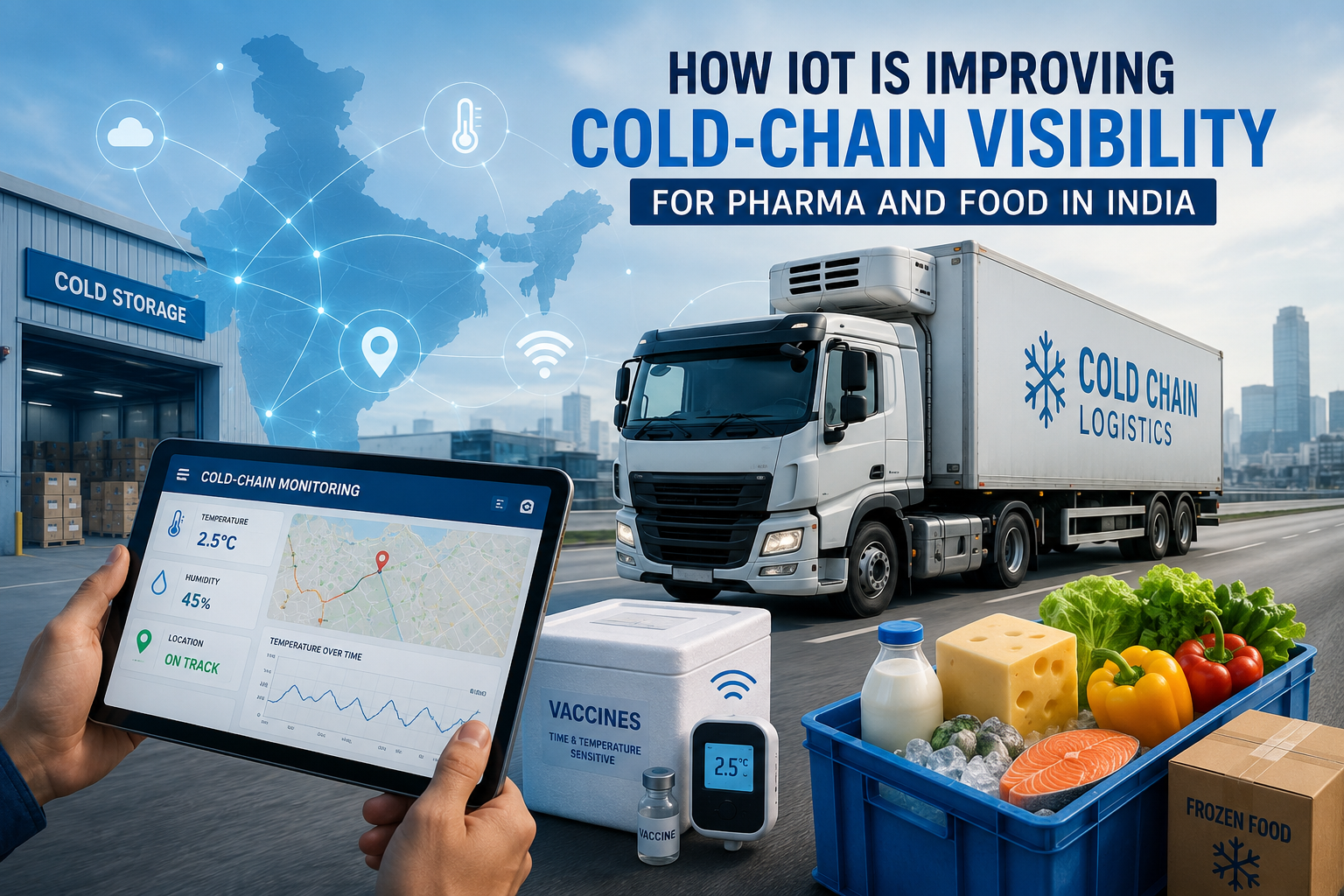
IoT (Internet of Things is the use of smart devices and sensors that collect real-time data and send it over the internet for monitoring and better decision-making)is changing cold-chain logistics in India by giving businesses real-time visibility of temperature-sensitive shipments.
Instead of waiting for manual records or customer complaints, companies can now track temperature, humidity, location, and shipment condition while the products are moving from the warehouse to the delivery point.
This is very important for the pharma and food industries because even a small temperature change can spoil products, reduce quality, or create compliance problems.
What Cold-Chain Visibility Means
Cold-chain visibility means knowing the exact condition of a product at every stage of its journey.
In the pharma industry, this includes medicines, vaccines, insulin, and biologics that must stay within a fixed temperature range.
In the food industry, it includes dairy products, frozen foods, seafood, meat, fresh fruits, vegetables, and other perishable items that can lose quality quickly if the cold chain is broken.
In a traditional system, companies often depend on paper records, manual inspections, or delayed reports.
This increases the risk because a temperature issue may be found only after the products are already damaged.
IoT reduces this risk by sending live data to dashboards, mobile apps, and control rooms, so the team can take action immediately.
How IoT Works in Cold Chain
IoT devices are installed in cold rooms, refrigerated trucks, storage boxes, or even on pallets and individual packages.
These devices continuously monitor temperature, humidity, GPS location, vibration, and door-opening events.
The collected data is sent to a cloud platform or control dashboard in real time.
If the temperature goes outside the safe limit, the system immediately sends an alert through SMS, email, or a mobile notification.
This allows the operations team to contact the driver, inspect the refrigeration unit, reroute the shipment, or move it to a nearby cold storage before the products are damaged.
In many cases, the digital record also proves that the shipment was handled properly.
Benefits for Pharma
Pharma logistics needs strict temperature control because medicines can lose their effectiveness if they become too hot or too cold.
IoT helps protect product quality by recording shipment conditions throughout the journey and creating a digital record for audits and compliance.
It also improves traceability, which is important when different partners are involved in storage, transport, and last-mile delivery.
Example: A batch of vaccines is being transported from a warehouse to a hospital.
During the journey, the refrigerated unit starts working poorly and the temperature begins to increase.
The IoT system sends an alert immediately.
The operations team contacts the driver, and the shipment is moved to a nearby approved cold facility before the vaccines are damaged.
This quick action can save both the products and patient safety.
Benefits for Food
Food logistics faces similar challenges, but it handles a wider variety of products that are often more time-sensitive.
Dairy products, frozen foods, seafood, fresh fruits, vegetables, and meat all need proper temperature control to stay fresh and safe.
IoT improves visibility throughout the journey, helping companies reduce spoilage and maintain product freshness.
Example: A dairy company transports chilled milk from a cold store to retail outlets.
If the truck’s refrigeration unit stops working for 20 minutes, the IoT device detects the temperature increase immediately.
The operations team can act quickly before the entire load is affected.
This can save a large part of the shipment and reduce customer complaints.
Why It Matters in India
India has a large and diverse cold-chain network that is often affected by traffic, weather conditions, and infrastructure challenges.
Because of this, good visibility is very important, as delays or equipment failures can happen at different points during transportation.
IoT helps solve these challenges by giving managers a live view of the shipment instead of depending on guesswork.
More companies in India are using IoT for cold-chain monitoring because of stricter compliance requirements, higher quality expectations, and the need to reduce waste.
Businesses now use these systems not only for monitoring but also for better planning, stronger customer trust, and faster response to problems.
In simple words, good visibility has become a business advantage, not just a technical feature.
Example Workflow
- A temperature-sensitive shipment is packed in a warehouse, and an IoT sensor is attached.
- The sensor starts sending live temperature and location data during transportation.
- During the journey, the refrigeration unit becomes weak and the temperature starts increasing.
- The control dashboard immediately sends an alert to the operations team.
- The team contacts the driver and decides whether to stop, reroute, or transfer the shipment.
- A complete digital record is available for compliance, audits, and customer proof.
Challenges to Consider
IoT gives the best results when it is supported by strong operational processes.
Sensors should be properly calibrated, internet connectivity should remain stable, and staff should respond quickly to alerts.
If alerts are ignored or the system is not maintained properly, the benefits of IoT are reduced.
That is why the best cold-chain operations combine technology with proper training, standard operating procedures (SOPs), and clear responsibility.
IoT provides the data, but disciplined operations make that data useful.
Conclusion
IoT is improving cold-chain visibility in India by making shipment conditions easy to monitor, track, and act upon in real time.
For the pharma industry, it helps protect medicine quality and supports compliance.
For the food industry, it reduces spoilage and keeps products fresh from the source to the store shelf.
As more businesses adopt smart monitoring systems, cold-chain logistics in India will become more reliable, more transparent, and much easier to manage.
FAQs
What is IoT in cold-chain logistics?
IoT in cold-chain logistics means using connected sensors and software to monitor temperature, humidity, location, and other shipment conditions during storage and transportation.
Why is IoT important for pharma?
IoT helps keep medicines and vaccines within safe temperature limits and creates a digital record for quality checks and compliance.
Why is IoT useful for food logistics?
It helps reduce spoilage, keeps food fresh, and allows companies to respond quickly when temperature problems occur.