
“`html
Logistics Explained: Meaning, Process, Types, Examples and Career Opportunities
Every product has a journey before it reaches the customer. It may move
from a supplier to a factory, from a factory to a warehouse, and then
through distribution and delivery centres before reaching its final
destination.
The planning, movement, storage, handling, and coordination involved in
this journey are collectively known as logistics. This complete guide
explains the meaning of logistics, how the process works, its major types,
transportation modes, technology, key performance indicators, examples,
and career opportunities.
What Is Logistics?
Logistics is the organized management of goods, materials, information,
and related resources as they move through different stages of a business
or distribution network.
It includes decisions about what should be moved, where it should go,
when it should arrive, where it should be stored, and how the movement
should be completed safely and efficiently.
In simple terms: Logistics is the coordination of
moving, storing, handling, tracking, and delivering goods from one
location to another.
Logistics also involves the people, vehicles, warehouses, equipment,
documents, information, and technology required to support the physical
flow of products.
Almost every industry depends on logistics, including manufacturing,
retail, e-commerce, pharmaceuticals, automobiles, agriculture, food
distribution, construction, and infrastructure.
Why Is Logistics Important?
A business may manufacture or sell an excellent product, but the product
must be available at the right location and at the right time. Effective
logistics helps connect suppliers, businesses, warehouses, retailers, and
customers.
Poor logistics can lead to delivery delays, damaged goods, stockouts,
excess inventory, higher transportation costs, inefficient warehouse
operations, and dissatisfied customers.
A well-planned logistics system helps businesses improve the flow of
materials and finished products.
- Raw materials can reach production facilities on time.
- Finished goods can move efficiently through the distribution network.
- Warehouses can maintain better inventory control.
- Vehicles and transportation capacity can be used more effectively.
- Customers can receive their orders within the promised timeframe.
- Unnecessary waiting, handling, and transportation costs can be reduced.
- Businesses can achieve better visibility of their operations.
- Delivery, inventory, and customer-service performance can improve.
How Does the Logistics Process Work?
Logistics is not a single activity. It is a series of connected processes
that ensure goods move from the point of origin to the required
destination.
1. Requirement Planning
The process begins by identifying what needs to be moved, how much is
required, where it is needed, and when it should arrive.
Logistics planners may consider customer demand, inventory levels,
production schedules, delivery commitments, vehicle availability, and
warehouse capacity.
2. Pickup or Receiving
Products or materials are collected from a supplier, manufacturer,
retailer, seller, customer, or another designated location.
When goods arrive at a warehouse, employees may check the quantity,
condition, documentation, product codes, and purchase order details before
recording the receipt in the system.
3. Storage and Put-Away
After receiving, goods may be moved to a warehouse, distribution centre,
fulfilment centre, cold-storage facility, or another suitable location.
The put-away process involves assigning products to the correct storage
location so that they can be found easily when required.
4. Material Handling
Products may need to be unloaded, moved, sorted, picked, packed,
labelled, scanned, consolidated, or loaded several times during their
journey.
Proper material handling reduces the risk of damage, improves employee
safety, and supports faster warehouse operations.
5. Transportation
The shipment is moved between locations using a suitable transportation
mode. The decision depends on distance, urgency, product type, shipment
size, route conditions, service requirements, and cost.
6. Delivery
The shipment reaches the required destination, such as a distributor,
retailer, business customer, store, collection point, or residential
address.
In e-commerce, delivery commonly includes the final movement from a local
delivery centre or last-mile hub to the customer’s location.
7. Tracking and Delivery Confirmation
Shipment status, location updates, delivery information, proof of
delivery, and exceptions may be recorded to provide visibility and
maintain accurate operational records.
Major Areas of Logistics
Logistics includes several connected operational areas. Depending on the
organization, these activities may be managed by separate departments or
by one integrated operations team.
-
Transportation Management:
Planning, scheduling, monitoring, and controlling the movement of goods. -
Warehouse Operations:
Managing receiving, put-away, storage, picking, packing, sorting, and dispatch. -
Inventory Control:
Maintaining accurate information about stock quantity, condition, and location. -
Order Fulfilment:
Converting customer orders into correctly picked, packed, labelled, and dispatched shipments. -
Material Handling:
Moving products safely within factories, warehouses, stores, and distribution facilities. -
Packaging:
Preparing goods for safe transportation, storage, handling, and delivery. -
Shipment Tracking:
Monitoring the progress, location, and status of goods while they are in transit. -
Reverse Logistics:
Managing returns, repairs, refurbishment, recycling, recovery, and product movement back through the network.
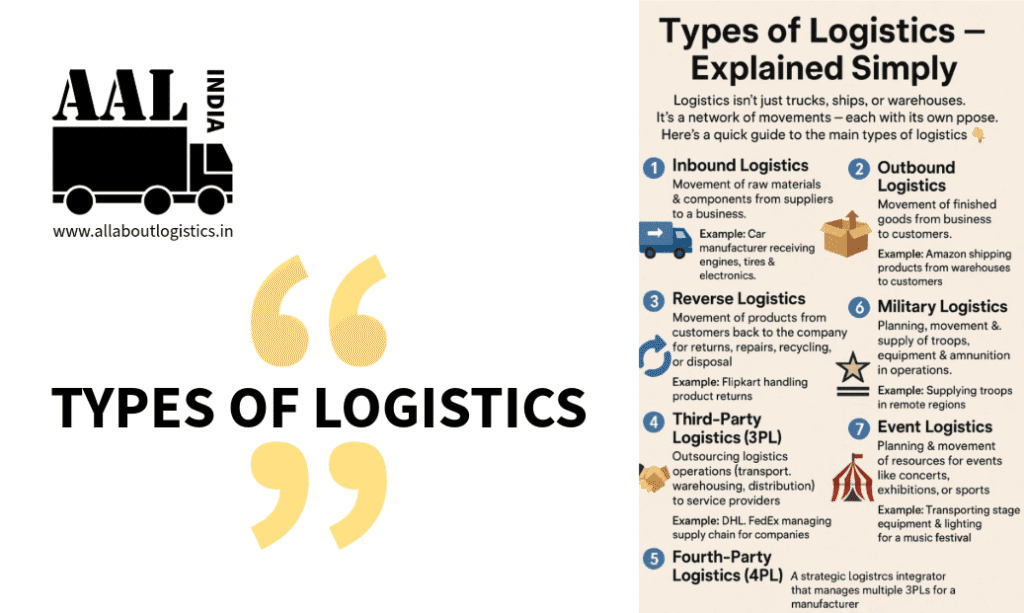
Types of Logistics
Inbound Logistics
Inbound logistics deals with the movement of materials, components,
packaging, and products into an organization.
For example, when a manufacturing plant receives steel, electronic
components, packaging materials, or ingredients from suppliers, the
activities involved are part of inbound logistics.
Outbound Logistics
Outbound logistics begins when finished products leave a factory,
warehouse, fulfilment centre, or distribution facility.
These products may move toward distributors, retailers, stores,
businesses, collection points, or final customers.
Reverse Logistics
Reverse logistics manages the movement of products or materials in the
opposite direction of the normal distribution flow.
Customer returns, product repairs, replacements, refurbishment,
recycling, resale, and recovery activities may all come under reverse
logistics.
Third-Party Logistics (3PL)
Third-party logistics, commonly called 3PL, refers to the use of an
external logistics company to provide services for another organization.
A 3PL provider may offer transportation, warehousing, order fulfilment,
distribution, packaging, inventory handling, or delivery services.
Fourth-Party Logistics (4PL)
Fourth-party logistics, or 4PL, generally involves a broader level of
coordination and supply-chain management.
A 4PL provider may integrate several logistics service providers,
technology systems, processes, facilities, and resources on behalf of a
client.
Transportation Modes in Logistics
No single transportation method is suitable for every shipment.
Logistics teams select a mode based on distance, urgency, cargo type,
shipment volume, service requirements, network availability, and cost.
Road Transportation
Road transport provides flexible connectivity between factories,
suppliers, warehouses, stores, hubs, businesses, and customers.
It is especially important for domestic distribution, first-mile
transportation, middle-mile movement, and last-mile delivery.
Rail Transportation
Rail can be useful for moving large quantities of cargo over longer
distances, particularly when suitable rail connectivity and schedules are
available.
Air Freight
Air freight is generally selected when delivery speed is a major priority
or when the value, urgency, or nature of the shipment justifies the higher
transportation cost.
Sea Transportation
Sea transport plays a major role in international trade and is commonly
used for large-volume cargo moving between countries.
Multimodal Transportation
Multimodal logistics uses more than one transportation mode during a
shipment’s journey.
For example, imported cargo may travel by sea from another country, by
rail or road between ports and inland terminals, and by road for final
delivery.
Logistics and Warehousing Difference
Warehousing is an important part of logistics, but the two terms do not
have the same meaning.
Warehousing mainly focuses on activities performed inside
a storage or distribution facility. These may include receiving,
inspection, put-away, storage, picking, packing, sorting, and dispatch.
Logistics has a wider scope. It can include
transportation, warehousing, inventory, packaging, order fulfilment,
material handling, shipment tracking, delivery coordination, and related
information flows.
Logistics vs Supply Chain Management
Logistics is one part of the broader supply chain. Supply-chain
management considers the complete network involved in sourcing,
procurement, production, inventory, logistics, distribution, suppliers,
customers, and business coordination.
| Logistics | Supply Chain Management |
|---|---|
| Focuses strongly on movement, storage, handling, and distribution. | Looks at the broader network and its overall coordination. |
| Includes transportation, warehousing, inventory handling, and delivery. | Can include sourcing, procurement, production, inventory, logistics, and distribution. |
| Often emphasizes the execution of the physical flow of goods. | Combines strategic planning with operational execution. |
| Helps move products and related information from one location to another. | Manages the end-to-end flow across multiple supply-chain participants. |
Simple Logistics Example
Consider a company selling packaged food through an online marketplace.
When a customer places an order, several logistics activities take place
before the package reaches the doorstep.
- The order is received by the seller or fulfilment system.
- The required product is identified in the inventory system.
- The item is picked from its warehouse location.
- The product is checked for quantity, quality, and order accuracy.
- The item is packed and labelled for transportation.
- The shipping label and required documents are prepared.
- The shipment is handed over to a transport or delivery partner.
- The package travels through sorting centres and distribution hubs.
- The shipment reaches the delivery facility serving the customer.
- The delivery executive completes the final-mile delivery.
- The delivery status and proof of delivery are recorded.
The customer may only see the final delivery, but many planning,
warehouse, transportation, technology, and coordination activities take
place behind it.
Role of Technology in Logistics
Modern logistics increasingly depends on digital systems. Technology
helps organizations collect operational data, coordinate activities,
monitor shipments, reduce errors, and make decisions using real-time or
near-real-time information.
Common logistics technologies include:
- Warehouse Management Systems (WMS).
- Transportation Management Systems (TMS).
- Enterprise Resource Planning (ERP) platforms.
- GPS-based vehicle and shipment tracking.
- Barcode scanning.
- QR-code identification.
- Radio-frequency identification (RFID).
- Digital proof of delivery.
- Route planning and optimization tools.
- Operational dashboards and analytics.
- Warehouse automation and robotics.
- Artificial intelligence and predictive analytics.
- Internet of Things sensors for temperature and location monitoring.
The purpose of technology is not simply to digitize existing work.
Effective technology should make logistics operations more visible,
accurate, responsive, safe, and efficient.
Important Logistics KPIs
Logistics teams use key performance indicators, or KPIs, to evaluate
service quality, cost, speed, productivity, and operational accuracy.
-
On-Time Delivery:
Measures whether shipments reach customers within the promised timeframe. -
OTIF:
Measures whether an order is delivered on time and in the correct quantity. -
Order Accuracy:
Shows how often orders are fulfilled without picking, packing, or shipping errors. -
Inventory Accuracy:
Compares the recorded stock quantity with the actual physical stock. -
Transportation Cost:
Tracks the cost of moving products between locations. -
Vehicle Utilization:
Helps determine how effectively available vehicle capacity is being used. -
Order Cycle Time:
Measures the time between order placement and fulfilment or delivery, depending on the defined process. -
Damage Rate:
Tracks the proportion of products or shipments damaged during handling or transportation. -
Warehouse Productivity:
Measures output such as orders picked, packed, or dispatched per labour hour.
Logistics in India
Logistics plays an important role in India’s manufacturing, retail,
agriculture, e-commerce, infrastructure, and distribution sectors.
Products may travel across cities, states, industrial areas, ports,
airports, rail terminals, warehouses, distribution centres, retail
outlets, dark stores, and delivery hubs before reaching their destination.
India’s logistics ecosystem includes transport operators, fleet owners,
warehouses, freight forwarders, courier and express companies, 3PL
providers, e-commerce fulfilment networks, technology companies, ports,
airports, rail networks, and many supporting service providers.
The growth of digital commerce, organized retail, manufacturing,
infrastructure, quick commerce, and technology-enabled services has
increased the importance of reliable and responsive logistics operations.
Career Opportunities in Logistics
Logistics offers career opportunities at operational, supervisory,
analytical, managerial, commercial, and technology-focused levels.
Common logistics and supply-chain roles include:
- Logistics Executive.
- Warehouse Executive.
- Dispatch Coordinator.
- Transport Coordinator.
- Fleet Supervisor.
- Inventory Executive.
- Order Fulfilment Associate.
- Warehouse Manager.
- Transport Manager.
- Logistics Manager.
- Supply Chain Analyst.
- Operations Manager.
- Procurement Professional.
- Demand Planning Executive.
- Distribution Centre Manager.
Career progression depends on education, practical experience, industry,
location, technical skills, communication ability, and the level of
responsibility handled.
Skills Required for a Logistics Career
A successful logistics professional needs a combination of operational
knowledge, coordination ability, problem-solving skills, and data
awareness.
- Communication and stakeholder coordination.
- Problem-solving and decision-making.
- Basic data analysis and reporting.
- Inventory and stock-control knowledge.
- Transportation and route-planning understanding.
- Warehouse process knowledge.
- Time management and prioritization.
- Cost awareness.
- Excel and spreadsheet skills.
- Knowledge of WMS, TMS, ERP, or delivery systems.
- Team supervision and leadership.
- Safety and compliance awareness.
Frequently Asked Questions
What is logistics in simple terms?
Logistics is the organized coordination of moving, storing, handling,
tracking, and delivering goods from one location to another.
Is logistics only about transportation?
No. Transportation is only one part of logistics. Logistics may also
include warehousing, inventory control, packaging, order fulfilment,
material handling, shipment tracking, and reverse logistics.
What is inbound logistics?
Inbound logistics deals with materials, components, products, or
packaging coming into a company, factory, warehouse, or operating
location.
What is outbound logistics?
Outbound logistics covers the movement of finished products from a
business, warehouse, or fulfilment facility toward distributors,
retailers, businesses, or final customers.
What does 3PL mean?
3PL means Third-Party Logistics. It refers to an external company that
provides logistics services such as transportation, warehousing,
fulfilment, or distribution for another business.
What is reverse logistics?
Reverse logistics manages the movement of products or materials back
through the supply network for returns, repairs, refurbishment,
recycling, resale, or recovery.
Is logistics a good career field?
Logistics provides opportunities across transportation, warehousing,
e-commerce, manufacturing, retail, distribution, freight, technology,
and supply-chain operations. Career growth depends on skills, education,
experience, performance, and the industry or role selected.
What is the difference between logistics and supply chain?
Logistics mainly focuses on the movement, storage, handling, and delivery
of goods. Supply-chain management has a broader scope and may include
sourcing, procurement, production, inventory, logistics, distribution,
suppliers, customers, and strategic coordination.
Final Thoughts
Logistics is the operational backbone that keeps products moving through
businesses and markets. It connects suppliers, factories, warehouses,
transportation networks, distributors, retailers, and customers.
Understanding logistics means understanding more than trucks and
deliveries. It means seeing how inventory, people, facilities,
information, technology, packaging, and transportation work together to
deliver the right product to the right place at the right time.
Whether you are a student exploring the field, a professional working in
operations, or a business owner improving distribution, a strong
understanding of logistics can help you make better operational
decisions.
Continue Learning
Explore more practical logistics articles, learning resources, quizzes,
career guidance, and tools on All About Logistics India.
4 thoughts on “What is Logistics ? Logistics Explained: Meaning, Process, Types, Examples and Career Opportunities”