
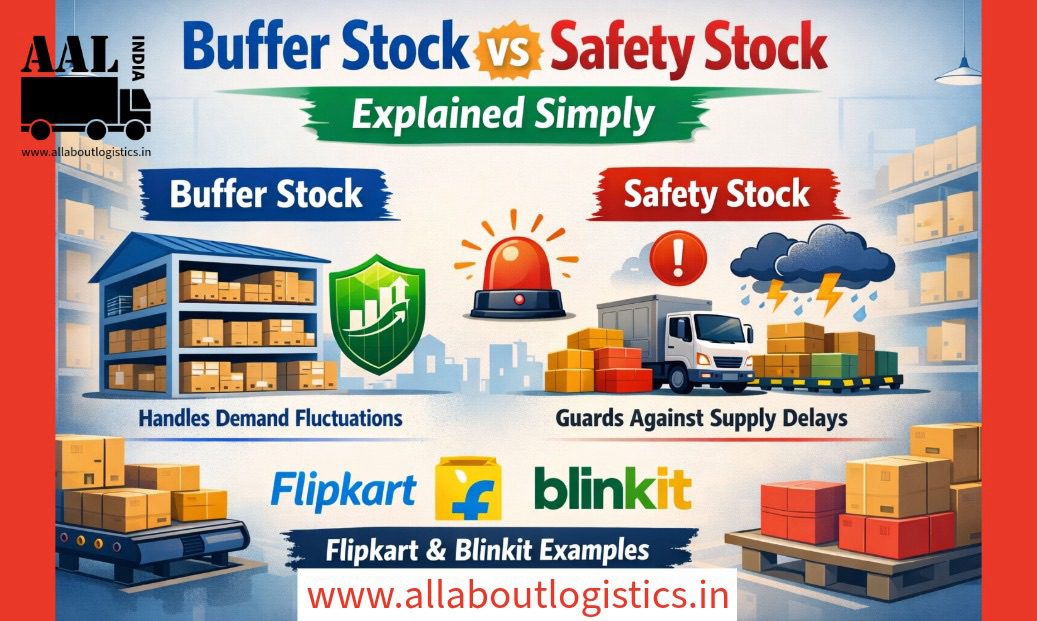
In inventory management, maintaining the right amount of stock is critical to balancing operational efficiency with customer satisfaction.
इन्वेंट्री मैनेजमेंट में सही मात्रा में स्टॉक बनाए रखना बहुत जरूरी होता है ताकि ऑपरेशन की efficiency और ग्राहक संतुष्टि के बीच संतुलन बना रहे।
Two fundamental concepts that help businesses achieve this balance are buffer stock and safety stock.
इस संतुलन को बनाए रखने में दो महत्वपूर्ण कॉन्सेप्ट मदद करते हैं — बफर स्टॉक और सेफ्टी स्टॉक।
While these terms are often used interchangeably, they serve distinct purposes and operate under different principles.
अक्सर लोग इन दोनों को एक जैसा समझते हैं, लेकिन इनका उपयोग और काम अलग-अलग होता है।
Understanding the difference between them is essential for any company managing supply chains, especially fast-paced e-commerce giants like Flipkart and Blinkit, where even a few hours of stockout can mean lost customers and revenue.
इन दोनों के बीच का अंतर समझना हर कंपनी के लिए जरूरी है, खासकर Flipkart और Blinkit जैसी कंपनियों के लिए, जहां कुछ घंटों का स्टॉक खत्म होना भी नुकसान का कारण बन सकता है।
This article explores buffer stock and safety stock in detail, explains their differences, provides calculation formulas, and illustrates their practical application using real-world examples from Flipkart’s fulfillment centers and Blinkit’s dark store network.
यह आर्टिकल बफर स्टॉक और सेफ्टी स्टॉक को विस्तार से समझाता है, उनका अंतर बताता है, फार्मूला देता है और Flipkart व Blinkit के उदाहरणों से समझाता है।
What Is Buffer Stock?
Buffer stock (also called cycle stock or demand buffer) is inventory held to absorb expected fluctuations in customer demand during normal business operations.
बफर स्टॉक (जिसे साइकिल स्टॉक भी कहते हैं) वह स्टॉक होता है जो सामान्य डिमांड के उतार-चढ़ाव को संभालने के लिए रखा जाता है।
It acts as a cushion against predictable variability, such as seasonal spikes, promotional surges, or regular demand fluctuations.
यह सीजनल डिमांड, ऑफर या नियमित बदलाव को संभालने के लिए एक कुशन की तरह काम करता है।
Key Characteristics of Buffer Stock
| Aspect | Description |
|---|---|
| Purpose | Handles foreseeable demand fluctuations |
| Focus | Demand-side variability; customer-oriented |
| Usage | Used regularly during normal operations |
| Calculation | Simpler formula based on average lead time and usage |
| Risk Mitigated | Stockouts from demand volatility |
यह टेबल दिखाता है कि बफर स्टॉक मुख्य रूप से डिमांड के बदलाव को संभालने के लिए उपयोग किया जाता है और यह रोज़मर्रा के काम में इस्तेमाल होता है।
Buffer Stock Formula
This formula accounts for the worst-case scenario of high demand combined with delayed replenishment, then subtracts the normal scenario to determine the extra inventory needed.
यह फार्मूला खराब स्थिति (ज्यादा डिमांड और देरी) को ध्यान में रखकर अतिरिक्त स्टॉक की गणना करता है।
Imagine a Flipkart fulfillment center in Delhi that sells Samsung smartphones. On average, they sell 50 units per day, and the lead time from the supplier is 5 days. However, during festival sales (Diwali), daily sales can spike to 150 units, and supplier delivery might delay to 7 days.• Average scenario: 50 × 5 = 250 units
• Worst-case scenario: 150 × 7 = 1,050 units
• Buffer stock needed: 1,050 − 250 = 800 units
This 800-unit buffer ensures Flipkart can meet surge demand during sales without stockouts.
इस उदाहरण में Flipkart को 800 यूनिट का बफर स्टॉक रखना होगा ताकि त्योहारी सीजन में ज्यादा डिमांड होने पर भी स्टॉक खत्म न हो।
What Is Safety Stock?
Safety stock is inventory held as an emergency reserve to protect against unpredictable supply chain disruptions.
सेफ्टी स्टॉक वह अतिरिक्त स्टॉक होता है जो इमरजेंसी के लिए रखा जाता है, ताकि सप्लाई चेन में अचानक आने वाली समस्याओं से बचा जा सके।
Unlike buffer stock, which handles expected demand changes, safety stock guards against unforeseen events like supplier delays, production failures, natural disasters, or sudden demand spikes beyond forecasts.
बफर स्टॉक जहां अनुमानित डिमांड को संभालता है, वहीं सेफ्टी स्टॉक अचानक होने वाली समस्याओं जैसे सप्लायर की देरी, प्रोडक्शन फेलियर या अचानक बढ़ी डिमांड को संभालता है।
Key Characteristics of Safety Stock
| Aspect | Description |
|---|---|
| Purpose | Guards against unpredictable supply disruptions |
| Focus | Supply-side uncertainty; supplier-oriented |
| Usage | Used only in emergencies |
| Calculation | Complex formula factoring demand and lead time variability |
| Risk Mitigated | Stockouts from supply chain disruptions |
यह टेबल दिखाता है कि सेफ्टी स्टॉक मुख्य रूप से सप्लाई की अनिश्चितता को संभालने के लिए होता है और इसे केवल इमरजेंसी में इस्तेमाल किया जाता है।
Safety Stock Formula
A more advanced method incorporates standard deviations:
एक एडवांस तरीके में डिमांड और लीड टाइम के बदलाव (variation) को भी शामिल किया जाता है।
Where Z is the service level factor (e.g., 1.65 for 95% service level), and σ represents standard deviation.
यहां Z सर्विस लेवल को दर्शाता है (जैसे 95% के लिए 1.65), और σ का मतलब है variation या standard deviation।
Consider Blinkit’s micro-fulfillment center (dark store) in Gurgaon that delivers groceries in 10 minutes. They stock milk, expecting daily demand of 500 liters with a 1-day lead time from dairy suppliers. However, a sudden roadblock delays delivery by 2 days, and demand unexpectedly spikes to 800 liters due to a local event.• Average demand during normal lead time: 500 × 1 = 500 liters
• Without safety stock: Stockout after 500 liters
• With safety stock of 300 liters (for 2 extra safety days): Total available = 800 liters
This 300-liter safety stock prevents stockouts during the emergency, ensuring Blinkit maintains its 10-minute delivery promise.
इस उदाहरण में Blinkit 300 लीटर सेफ्टी स्टॉक रखता है ताकि सप्लाई में देरी और अचानक बढ़ी डिमांड के दौरान भी ग्राहक को दूध मिलता रहे।
Key Differences Between Buffer Stock and Safety Stock
| Aspect | Buffer Stock | Safety Stock |
|---|---|---|
| Primary Purpose | Manage expected demand fluctuations | Protect against supply chain uncertainties |
| When Used | Regularly during operations | Only in emergencies |
| Focus Area | Customer demand volatility | Supplier reliability and lead time variability |
| Calculation Complexity | Simpler, based on averages | Complex, includes variability statistics |
| Analogy | Demand shock absorber | Supply chain parachute |
यह टेबल दिखाता है कि बफर स्टॉक डिमांड के उतार-चढ़ाव को संभालता है, जबकि सेफ्टी स्टॉक सप्लाई से जुड़ी अनिश्चितताओं को संभालता है।
Buffer stock is like your car’s suspension—smoothly handling regular bumps—while safety stock is your airbag, deploying only during crashes.
बफर स्टॉक गाड़ी के सस्पेंशन की तरह है जो छोटे झटकों को संभालता है, जबकि सेफ्टी स्टॉक एयरबैग की तरह है जो केवल बड़े संकट में काम आता है।
Flipkart’s Fulfillment Center: Buffer and Safety Stock in Action
Flipkart, India’s largest e-commerce platform, operates over 500 warehouses ranging from major regional hubs to smaller fulfillment centers.
Flipkart, भारत का एक बड़ा ई-कॉमर्स प्लेटफॉर्म, 500 से अधिक वेयरहाउस ऑपरेट करता है, जिनमें बड़े हब और छोटे फुलफिलमेंट सेंटर शामिल हैं।
Their inventory management uses a continuous review model, replenishing stock when it reaches the reorder point (ROP).
इनका इन्वेंट्री सिस्टम continuous review मॉडल पर काम करता है, जिसमें स्टॉक ROP (Reorder Point) पर पहुंचने पर फिर से मंगाया जाता है।
How Flipkart Uses Buffer Stock
During Big Billion Days (Flipkart’s flagship sale), demand for electronics like iPhones can spike 5–10x.
Flipkart की Big Billion Days सेल के दौरान iPhone जैसे प्रोडक्ट की डिमांड 5 से 10 गुना तक बढ़ सकती है।
Flipkart calculates buffer stock for each SKU based on:
Flipkart हर प्रोडक्ट के लिए बफर स्टॉक इन बातों के आधार पर तय करता है:
- Historical sale data from previous years
- Expected traffic and conversion rates
- Maximum lead time from suppliers
• पिछले सालों का सेल डेटा
• वेबसाइट ट्रैफिक और कन्वर्जन रेट
• सप्लायर से अधिकतम डिलीवरी समय
• Average daily iPhone sales: 200 units
• Maximum daily sales during sale: 1,500 units
• Average lead time: 3 days
• Maximum lead time: 5 daysBuffer Stock = (1,500 × 5) − (200 × 3) = 7,500 − 600 = 6,900 units
Flipkart pre-stocks 6,900 extra iPhones to handle the surge without stockouts.
इस उदाहरण में Flipkart 6,900 अतिरिक्त iPhones पहले से स्टॉक करता है ताकि सेल के दौरान स्टॉक खत्म न हो।
How Flipkart Uses Safety Stock
Flipkart also maintains safety stock for critical components where supplier delays could halt operations.
Flipkart जरूरी प्रोडक्ट्स के लिए सेफ्टी स्टॉक भी रखता है ताकि सप्लाई में देरी होने पर काम न रुके।
For electronics, chip shortages or logistics bottlenecks are real risks.
इलेक्ट्रॉनिक्स में चिप की कमी या लॉजिस्टिक्स की समस्या आम जोखिम होते हैं।
• Average daily usage: 100 units
• Safety days maintained: 7 days
• Safety stock: 100 × 7 = 700 unitsThis 700-unit reserve ensures Flipkart can continue fulfilling orders even if suppliers delay by a week.
यह 700 यूनिट का सेफ्टी स्टॉक Flipkart को एक हफ्ते तक सप्लाई रुकने पर भी ऑर्डर पूरा करने में मदद करता है।
Flipkart employs FIFO (First-In, First-Out) inventory management, ensuring older stock ships first to prevent obsolescence.
Flipkart FIFO (First-In, First-Out) सिस्टम का उपयोग करता है ताकि पुराना स्टॉक पहले बिके और नुकसान न हो।
Blinkit’s Dark Stores: Quick Commerce and Inventory Strategy
Blinkit (formerly Grofers) operates a hyperlocal quick-commerce model with micro-fulfillment centers (dark stores) placed in high-density areas to enable 10–20 minute deliveries.
Blinkit (पहले Grofers) एक hyperlocal quick-commerce मॉडल पर काम करता है, जिसमें छोटे-छोटे डार्क स्टोर शहर के भीड़भाड़ वाले इलाकों में बनाए जाते हैं ताकि 10–20 मिनट में डिलीवरी हो सके।
In September 2025, Blinkit shifted to an inventory-led model, taking direct control over supply chains to improve margins and reliability.
सितंबर 2025 में Blinkit ने inventory-led मॉडल अपनाया, जिससे सप्लाई चेन पर सीधा कंट्रोल लेकर बेहतर मार्जिन और विश्वसनीयता हासिल की जा सके।
Blinkit’s Buffer Stock Strategy
Blinkit uses a zonal warehouse model to replenish dark stores daily, ensuring consistent supply of high-demand FMCG items.
Blinkit zonal warehouse मॉडल का उपयोग करता है और रोज़ाना डार्क स्टोर को रीफिल करता है ताकि FMCG प्रोडक्ट्स की सप्लाई लगातार बनी रहे।
Buffer stock is calculated for each product category.
हर प्रोडक्ट कैटेगरी के लिए अलग-अलग बफर स्टॉक तय किया जाता है।
• Average daily sales: 200 loaves
• Maximum daily sales (weekend): 400 loaves
• Average lead time: 0.5 days
• Maximum lead time: 1 dayBuffer Stock = (400 × 1) − (200 × 0.5) = 400 − 100 = 300 loaves
This buffer ensures Blinkit meets weekend demand surges without running out of fresh bread.
इस उदाहरण में Blinkit 300 ब्रेड का बफर स्टॉक रखता है ताकि वीकेंड पर ज्यादा डिमांड होने पर भी स्टॉक खत्म न हो।
Blinkit’s Safety Stock Strategy
For perishables like milk and vegetables, Blinkit maintains safety stock to handle traffic delays, weather disruptions, or vendor shortages.
दूध और सब्जियों जैसे जल्दी खराब होने वाले प्रोडक्ट के लिए Blinkit सेफ्टी स्टॉक रखता है ताकि ट्रैफिक, मौसम या सप्लायर की समस्या को संभाला जा सके।
• Average daily demand: 600 liters
• Safety days: 1 day
• Safety stock: 600 × 1 = 600 litersIf a supplier truck gets stuck in traffic, the safety stock ensures Blinkit can still fulfill orders.
यह 600 लीटर का सेफ्टी स्टॉक Blinkit को सप्लाई में देरी होने पर भी ऑर्डर पूरा करने में मदद करता है।
ABC Classification for Inventory Optimization
Blinkit classifies inventory into ABC categories:
Blinkit अपने इन्वेंट्री को ABC कैटेगरी में बांटता है:
- A-items: High-value, high-frequency — highest safety stock
- B-items: Moderate value — moderate buffer
- C-items: Low-value — minimal stock
A-items: ज्यादा बिकने वाले — ज्यादा स्टॉक
B-items: मध्यम — मध्यम स्टॉक
C-items: कम बिकने वाले — कम स्टॉक
This approach reduces cost while avoiding stockouts.
इस तरीके से लागत कम होती है और जरूरी प्रोडक्ट का स्टॉक खत्म नहीं होता।
Why Both Buffer Stock and Safety Stock Are Necessary
Companies that rely on only one type of stock face risks.
जो कंपनियां केवल एक प्रकार के स्टॉक पर निर्भर रहती हैं, उन्हें जोखिम होता है।
| Scenario | Only Buffer | Only Safety | Both |
|---|---|---|---|
| Demand spike | ✅ | ❌ | ✅ |
| Supplier delay | ❌ | ✅ | ✅ |
दोनों का उपयोग करने से डिमांड और सप्लाई दोनों समस्याएं संभाली जा सकती हैं।
Best Practices
- Use Accurate Demand Forecasting
- Review Stock Regularly
- Focus on Important Products
- Use Real-Time Systems
- Build Strong Supplier Relationships
सही डिमांड का अनुमान लगाएं, स्टॉक को नियमित रूप से चेक करें और सप्लायर से अच्छे संबंध बनाएं।
Common Mistakes
| Mistake | Impact |
|---|---|
| Confusing buffer and safety stock | Wrong planning |
| Not updating data | Stock issues |
| Ignoring seasonality | Stockouts |
गलत समझ या अपडेट न करने से स्टॉक की समस्या हो सकती है।
Conclusion
Buffer stock and safety stock are both essential for smooth operations.
बफर और सेफ्टी स्टॉक दोनों जरूरी हैं ताकि बिजनेस सही तरीके से चले।
Buffer stock handles expected demand, while safety stock handles unexpected problems.
बफर स्टॉक अनुमानित डिमांड को संभालता है और सेफ्टी स्टॉक अचानक समस्याओं को।
Using both ensures better customer satisfaction and fewer stockouts.
दोनों का उपयोग करने से ग्राहक संतुष्टि बढ़ती है और स्टॉक खत्म होने की समस्या कम होती है।
2 thoughts on “Buffer Stock vs Safety Stock Explained Simply (Flipkart & Blinkit Examples)”