
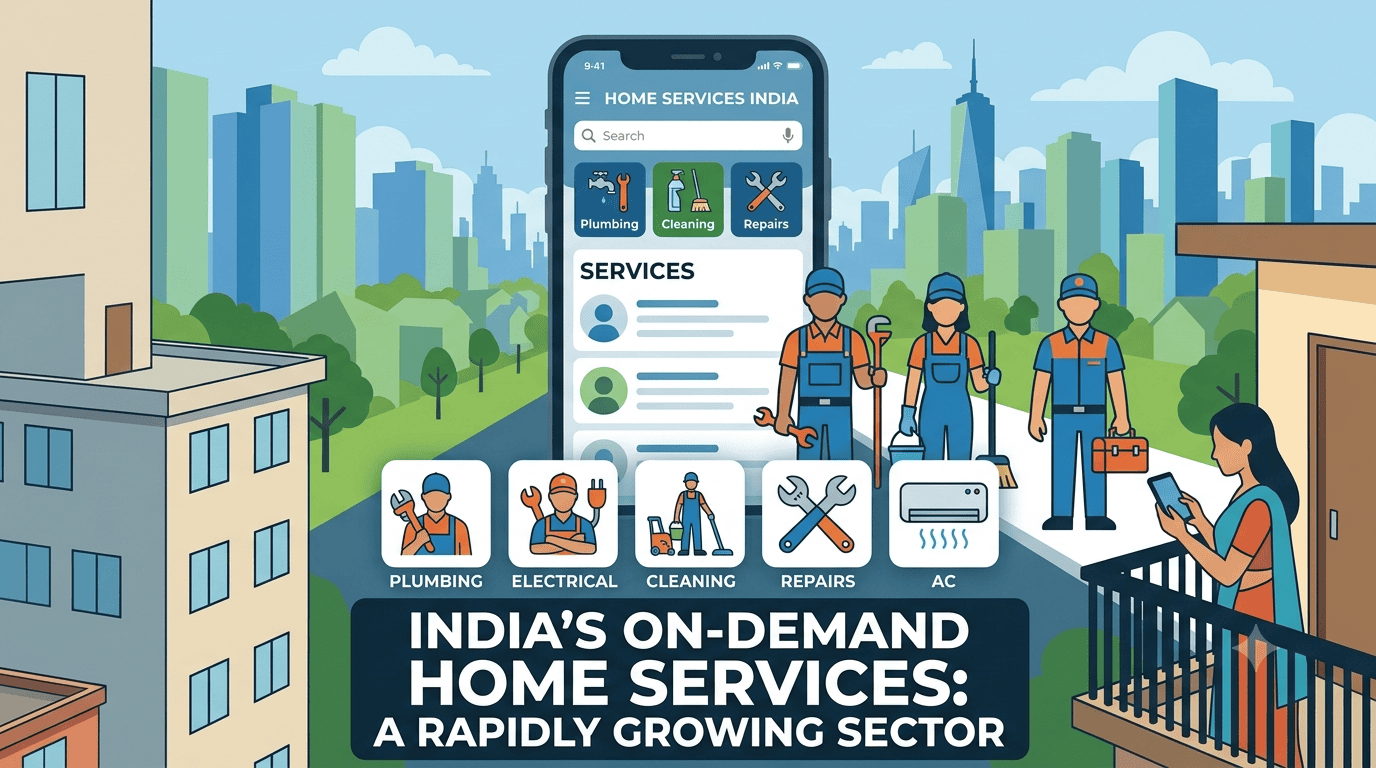
What Is the On-Demand Home Services Sector?
The on-demand home services sector refers to digital platforms that connect customers with service professionals for household tasks on a flexible, need-based basis. Instead of hiring a full-time maid or helper, users can book services only when needed. This can be for one-time support, recurring chores, emergency help, or task-based assistance.
The model is similar to other app-based convenience businesses. A customer places a request through a mobile application or website, the platform matches the request with an available worker, and the service is fulfilled within a specific time window. The goal is to make domestic support faster, more reliable, and easier to manage.
Why This Sector Is Growing
India’s urban lifestyle is changing rapidly. More people are working long hours, living in nuclear families, and managing busy schedules that leave less time for household chores. This has created a strong demand for flexible home services that can be booked on demand.
The growth of digital adoption has also played a major role. Consumers in India are now comfortable using apps for food delivery, transport, payments, and grocery shopping. The same behavior is now extending to household services, which gives the sector a strong foundation for future expansion.
Another reason for the sector’s rise is the large informal domestic help market in India. A significant share of household help still operates offline and without digital organization. This creates a massive opportunity for platforms that can bring structure, consistency, and convenience to the market.
How The Business Model Works
The on-demand home services business model is based on connecting supply and demand efficiently. On one side are households that need help, and on the other side are trained workers available to provide those services. The platform acts as the bridge between them.
Most companies in this sector operate through service fees, commissions, convenience charges, subscriptions, or bundled packages. Some focus on individual bookings, while others offer recurring plans for customers who need regular support. The platform must also invest in customer support, worker training, quality control, and technology infrastructure.
This model is more difficult than it looks because it is a hybrid of digital technology and physical operations. Unlike pure software businesses, home service platforms depend on people arriving on time, completing work properly, and maintaining a consistent standard of service.
Types of Services Offered
The sector covers a wide range of home-related needs. Some of the most common services include housekeeping, deep cleaning, utensil washing, laundry help, kitchen assistance, cooking support, appliance repair, salon-at-home services, and other home-based convenience offerings.
Over time, platforms are also expanding into related categories such as elder care, childcare, beauty services, and maintenance support. This expansion is important because it helps platforms increase customer lifetime value and improve repeat usage.
Market Scope In India
The scope of the on-demand home services market in India is very large. This is because household help is a daily need for millions of urban families, yet the market remains highly fragmented and under-digitized. That combination creates a strong business opportunity for organized digital players.
India’s urban population continues to grow, and so does the number of working professionals, dual-income families, apartment dwellers, and mobile-first consumers. These groups are more likely to pay for services that save time and reduce daily stress. This makes the sector attractive not only in metros but also in large tier-2 cities.
The market also has room for broader category expansion. Once a platform earns customer trust, it can move from cleaning into recurring domestic support, from kitchen help into meal prep, and from general assistance into specialty home services. That creates a long runway for growth.
How Companies Compete
Competition in this sector is based on more than pricing. Customers care about whether the service is reliable, whether the worker is trained, whether the booking process is simple, and whether the company resolves issues quickly. Trust is one of the most important competitive advantages in this business.
Speed is also critical. Since many users want immediate or same-day service, platforms that can fulfill requests faster often win more customers. That is why many companies focus on hyperlocal operations and zone-based service delivery.
Another key factor is service consistency. If a customer has a good experience once, they are more likely to return. This makes repeat customers extremely valuable, especially in a market where customer acquisition costs can be high.
Major Players In The Sector
The Indian on-demand home services market includes both established platforms and newer startups. Urban Company is one of the most recognized names in the broader home services category and has built strong brand visibility across multiple service lines.
Newer companies such as Snabbit, Broomees, and Pronto are also contributing to the growth of this sector by focusing on specific use cases and faster service delivery. While some platforms emphasize professional services and repairs, others are more focused on domestic help and household support.
This mix of players shows that the sector is still early in its evolution. Because the market is large and fragmented, there is still space for multiple business models to coexist and grow.
Why Consumers Are Adopting It
Consumers are adopting on-demand home services because they want convenience, flexibility, and peace of mind. Many people no longer want to depend entirely on informal arrangements that may be unreliable or difficult to manage. Digital platforms offer a more predictable experience.
App-based booking also makes the process easier to control. Customers can choose when they want the service, what type of help they need, and sometimes even how long the work should take. This level of control is highly attractive in fast-paced urban life.
Transparency is another reason for adoption. Digital platforms often provide visible pricing, service details, worker profiles, and support channels. That reduces uncertainty and increases trust compared to offline methods.
Challenges In The Industry
The biggest challenge in this sector is operational complexity. A platform may have great technology, but if workers are delayed, unavailable, or inconsistent, the customer experience suffers. Managing local demand and supply in real time is difficult.
Worker retention is another major issue. Service providers want fair pay, regular work, safety, and dignity. If these expectations are not met, churn can become a serious problem. This means platforms must invest not only in customer acquisition but also in worker satisfaction.
There are also concerns around regulations, labor rights, insurance, and service liability. As the gig economy matures in India, platforms will need to build stronger systems for compliance, safety, and worker welfare.
Technology And Operations
Technology plays a major role in this industry, but ground operations are equally important. Platforms use apps, scheduling systems, route optimization, customer support dashboards, and data analytics to manage bookings and worker allocation. These tools help improve service speed and efficiency.
At the same time, the business relies on training, neighborhood-level planning, quality checks, and worker availability. A well-designed app can help the process, but it cannot replace the need for strong field execution. That is why successful companies in this sector usually combine digital systems with hands-on local management.
Investment And Growth Potential
Investors are interested in the on-demand home services sector because it solves a large everyday problem with a scalable digital model. The market is broad, the demand is recurring, and the consumer use case is easy to understand. These are all positive signs for long-term category growth.
The growth potential is especially strong in urban India, where more households are willing to pay for time-saving services. As service quality improves and customer trust rises, the sector could expand from a convenience option into a routine part of everyday life.
However, investors also know that this is not an easy business. It requires strong capital planning, local execution, and patience before profitability improves. The businesses that succeed will be the ones that can balance scale with efficiency.
Future Outlook
The future of the on-demand home services sector in India looks promising. As consumer habits continue shifting toward app-based convenience, more households are likely to try these services. The category is still early, which means there is room for innovation, expansion, and category creation.
In the coming years, platforms may offer more specialized services, stronger subscription models, and deeper city coverage. The sector could also benefit from better worker training, improved safety systems, and more organized digital infrastructure.
If these improvements happen, the industry may become one of the most important service categories in India’s urban economy. It has the potential to reshape how households access daily help and how service professionals find meaningful work.
Frequently Asked Questions
What is the on-demand home services sector?
It is a digital services category where customers book household help, cleaning, or related domestic services through apps or websites.
Why is the sector growing in India?
It is growing because urban consumers want convenience, flexibility, and reliable household support.
Who are the main competitors?
The market includes companies like Urban Company, Snabbit, Broomees, and Pronto.
What are the main challenges?
The major challenges include operational complexity, worker retention, service quality, and regulatory issues.
Is the market large enough for future growth?
Yes, the market is large and still under-digitized, so there is significant room for more growth and innovation.
Conclusion
The on-demand home services sector in India is a fast-growing and highly promising category. It combines convenience, technology, and real household needs in a market that is still being organized. With strong demand, growing digital adoption, and increasing urban complexity, this sector has the potential to become a major part of India’s service economy.
For startups, marketers, and investors, this is a category worth watching closely. The companies that can solve trust, speed, and service quality will likely shape the future of home services in India.