Swiggy Instamart Gas Cylinder Delivery: A Big Opportunity with Big Challenges
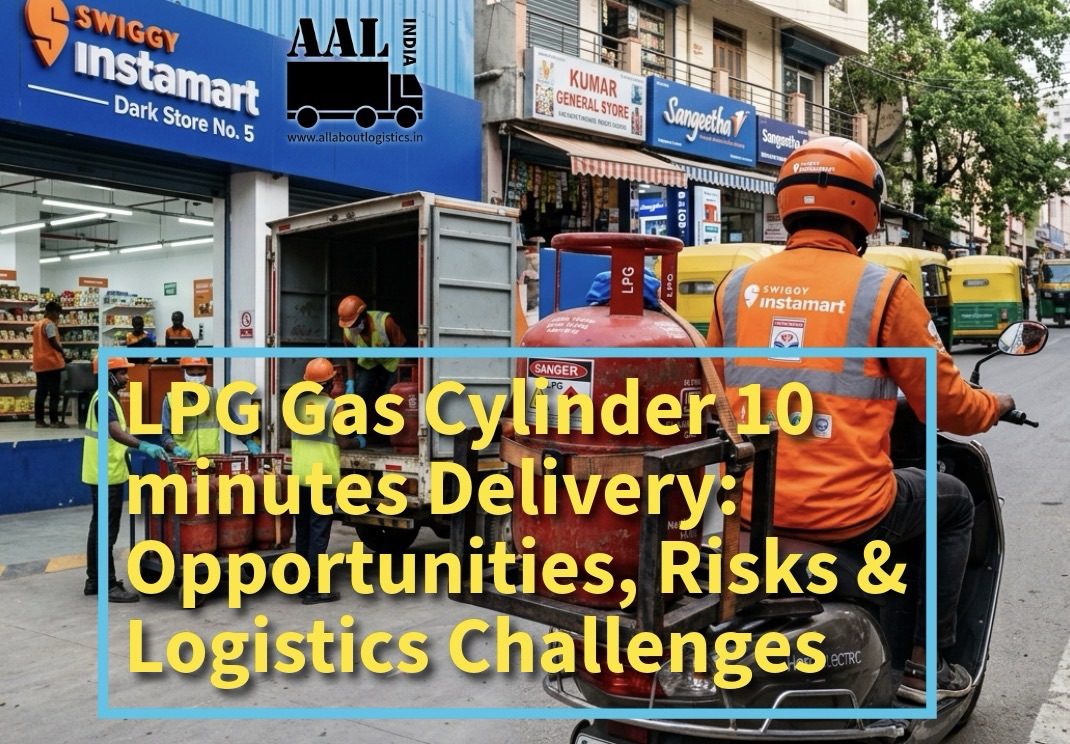
India’s quick commerce industry is growing rapidly. What started with groceries and medicines is now expanding into products like LPG gas cylinders. Swiggy Instamart’s pilot project with HPCL is an important step in this direction. While this service offers great convenience to customers, it also brings serious safety, regulatory, and logistics challenges.
Unlike groceries, LPG cylinders are hazardous products that require strict handling, trained personnel, and compliance with government regulations. This makes gas cylinder delivery one of the most complex last-mile logistics services in India’s quick-commerce industry.
LPG सिलेंडर सामान्य ग्रोसरी उत्पाद नहीं है। यह एक Hazardous (खतरनाक) और Pressurized (दबावयुक्त) उत्पाद है, जिसकी स्टोरेज, परिवहन और डिलीवरी के लिए प्रशिक्षित कर्मचारियों, सुरक्षित वाहनों, उचित इंफ्रास्ट्रक्चर और सख्त Standard Operating Procedures (SOPs) की आवश्यकता होती है।
इस सेवा की सफलता केवल तेज़ डिलीवरी पर निर्भर नहीं करेगी। कंपनियों को सुरक्षा मानकों का पालन, सरकारी नियमों का अनुपालन, प्रशिक्षित डिलीवरी पार्टनर्स, मजबूत इन्वेंट्री नियंत्रण, डिजिटल ट्रैकिंग और प्रभावी ऑपरेशनल सिस्टम विकसित करने होंगे।
यदि क्विक कॉमर्स कंपनियाँ गति और सुरक्षा के बीच सही संतुलन बना पाती हैं, तो LPG सिलेंडर की क्विक डिलीवरी भारत में लास्ट-माइल लॉजिस्टिक्स का एक नया अध्याय बन सकती है। यह न केवल ग्राहकों की सुविधा बढ़ाएगी, बल्कि भविष्य में अन्य नियंत्रित (Regulated) और संवेदनशील उत्पादों की डिलीवरी के लिए भी एक मजबूत मॉडल तैयार कर सकती है।
Swiggy Instamart and HPCL: A New Chapter in Quick Commerce
For customers, the experience is as simple as ordering groceries online. However, the operations behind the scenes are completely different. LPG cylinders are part of a highly regulated energy supply chain that involves licensed distributors, strict storage rules, transportation standards, and customer verification.
Since this is still a pilot project, its expansion will depend on operational success and regulatory approvals. This clearly shows that gas cylinder delivery through quick commerce is still in its early stage.
Which LPG Cylinders Are Being Delivered?
- HP Navya 10 kg Composite LPG Cylinder: A lightweight composite cylinder with a modern ergonomic design. Unlike conventional steel cylinders, it has a translucent body that allows customers to check the remaining LPG level. It is also corrosion-resistant, easier to carry, and suitable for small families, apartments, and as a secondary kitchen cylinder.
- HPCL 5 kg Steel LPG Cylinder: A compact and portable steel cylinder designed for small households, temporary use, travel, hostels, and emergency cooking needs. Its smaller size makes transportation and last-mile delivery more practical.
By introducing these smaller and lighter cylinders, Swiggy Instamart and HPCL aim to make LPG delivery safer, faster, and more suitable for quick-commerce operations while reducing the handling challenges associated with conventional 14.2 kg domestic cylinders.
Why Gas Cylinders Are Different from Grocery Products
Quick-commerce platforms were originally designed to deliver everyday household items quickly. Gas cylinders are very different because they contain flammable gas stored under pressure and must be handled with extra care.
- Gas cylinders contain highly pressurised gas. Any damage or leakage can lead to fire or even an explosion.
- Their transportation is treated as hazardous goods movement, which requires approved cylinders, proper fittings, and safety equipment.
- Every cylinder delivery must follow government regulations, including customer verification, booking records, and distributor approvals.
Because of these requirements, delivering LPG cylinders is much more complex than delivering groceries. In this category, Swiggy Instamart has to operate more like a specialised logistics company than a normal grocery delivery platform.
Safety Challenges in Gas Cylinder Delivery
Safety is the biggest challenge in quick-commerce gas delivery. Unlike grocery orders, LPG cylinders cannot be delivered using a “speed-first” approach.
- High-pressure risk: LPG cylinders store flammable gas under pressure. Dropping a cylinder, damaging its valve, or storing it incorrectly can cause dangerous gas leaks.
- Need for proper training: Most delivery partners are trained to deliver groceries and parcels, not hazardous products. Without proper training, they may unknowingly handle cylinders in unsafe ways, such as laying them horizontally or placing them near heat sources.
- Vehicle and storage requirements: Regular grocery delivery vehicles may not have proper cylinder supports, ventilation, or fire safety equipment. Similarly, dark stores designed for FMCG products may need changes to safely store LPG cylinders separately and in an upright position.
To make this service successful, companies must invest in specialised training, safer delivery vehicles, improved warehouse layouts, and strict Standard Operating Procedures (SOPs).
Regulatory and Compliance Challenges
Delivering LPG cylinders is very different from delivering groceries because it is governed by strict government regulations. Quick-commerce platforms cannot simply add gas cylinders as another product category without following these rules.
- Every LPG cylinder must be manufactured, tested, stored, transported, and handled according to government safety standards.
- Since LPG is a hazardous product, vehicles carrying cylinders must meet specific safety requirements, including approved fittings and fire safety equipment.
- Every stage of the supply chain—from the bottling plant to the customer’s doorstep—requires proper documentation, inspections, and compliance.
Quick-commerce companies must work closely with oil marketing companies and regulatory authorities. Ignoring these rules can lead to penalties, suspension of operations, or cancellation of pilot projects. Compliance is not optional—it is the foundation of safe LPG delivery.
Supply Chain and Operational Challenges
India’s LPG distribution network is already a large and complex supply chain. Adding quick-commerce delivery creates new operational challenges that companies must carefully manage.
- In some cities, customers already experience delays because of high demand or limited distributor capacity.
- Sudden increases in orders can put extra pressure on inventory, transportation, and delivery operations.
- Quick-commerce companies also need to balance LPG deliveries with their regular grocery orders while maintaining safety and delivery timelines.
Unlike grocery orders, LPG deliveries cannot simply be added to the existing delivery route. Companies need dedicated planning, trained delivery teams, and well-designed operating processes to ensure both speed and safety.
Fraud, Ghost Deliveries, and Black Market Risks
LPG distribution has faced issues such as fraud and illegal diversion for many years. If proper controls are not in place, quick-commerce delivery could increase these risks.
- One common issue is “ghost delivery,” where a cylinder is marked as delivered in the system even though it never reaches the customer.
- Some cylinders may be diverted and sold illegally at higher prices in the black market.
- Many customers are unaware of the complaint process, allowing fraudulent activities to continue without being reported.
To reduce these risks, companies should use strong verification methods such as OTP confirmation, digital proof of delivery, photographs, GPS tracking, and regular inventory reconciliation. Every cylinder should be traceable from dispatch to final delivery.
Customer Experience and Building Trust
For customers, fast LPG delivery is a highly attractive service. Many households have experienced delays with the traditional booking process, so receiving a cylinder within a short time can greatly improve convenience.
However, trust is extremely important in this category. Customers can forgive a late grocery delivery, but they expect complete safety when dealing with LPG cylinders. Even a single major accident could damage public confidence in the entire service.
To build trust, companies should clearly communicate their safety standards, provide trained delivery personnel, follow proper handling procedures, and offer quick customer support whenever required.
Business and Profitability Challenges
Delivering LPG cylinders is not only a logistics challenge but also a business challenge. Unlike groceries, gas cylinders require higher investment in safety, compliance, and specialised operations.
- Companies need trained delivery personnel, specialised vehicles, and proper safety equipment.
- Additional costs such as insurance, regulatory compliance, and employee training increase the overall operating expense.
- Changes in LPG prices, government policies, or supply availability can directly impact business performance.
- Unlike grocery products, LPG cylinder deliveries cannot always be scaled quickly because every operation must meet strict safety standards.
For this reason, gas cylinder delivery may not generate high profits in the beginning. However, it can become an important value-added service that improves customer convenience and strengthens brand loyalty.
A Typical Swiggy Instamart LPG Delivery Journey
Although customers place an order with just a few taps, several important steps take place before the cylinder reaches their home.
- The customer selects an LPG cylinder through the Swiggy Instamart app.
- The system verifies service availability, inventory, and delivery eligibility for the customer’s location.
- The order is forwarded to an authorised HPCL distributor or an approved fulfilment point.
- A trained delivery partner collects the cylinder after checking for visible damage and ensuring it is safe for transportation.
- The cylinder is transported using approved handling procedures while following all safety guidelines.
- At the customer’s location, the delivery is completed using OTP verification or other approved proof of delivery methods.
Every step is important. Missing a safety inspection, incorrect handling, or poor documentation can increase the risk of accidents, compliance issues, or fraud.
What Lies Ahead?
The partnership between Swiggy Instamart and HPCL is an important step in the evolution of India’s quick-commerce industry. It shows how digital platforms are expanding beyond groceries into essential household services.
However, LPG cylinder delivery is very different from traditional e-commerce. Companies must build specialised operating models that focus on safety, compliance, workforce training, and risk management instead of only reducing delivery time.
If this pilot succeeds, it could encourage other quick-commerce companies to explore similar services. At the same time, regulators and oil marketing companies will continue to play a key role in ensuring that safety is never compromised.
Conclusion
Quick commerce has transformed how people buy groceries and everyday essentials. Delivering LPG cylinders could become the next major milestone, offering customers greater convenience when they need an essential product urgently.
But speed alone cannot define success. Safe handling, trained personnel, regulatory compliance, proper infrastructure, and strong operational controls are equally important.
For logistics professionals, this pilot is more than just a new delivery service. It represents the beginning of a specialised last-mile logistics model for hazardous products. Companies that successfully balance speed, safety, and operational excellence will be better positioned to shape the future of gas cylinder delivery in India.
Key Takeaways
- Gas cylinder delivery is one of the most complex services in quick commerce because it involves hazardous goods.
- Safety should always take priority over delivery speed.
- Compliance with government regulations is essential throughout the supply chain.
- Delivery partners require specialised training to handle LPG cylinders safely.
- Digital tracking, OTP verification, and inventory reconciliation can help reduce fraud and improve accountability.
- The long-term success of LPG quick commerce will depend on balancing customer convenience with safety, compliance, and operational efficiency.